I had some fun time reading http://onlinestatbook.com/2/regression/intro.html today. It includes formulas for calculating linear regression of a data set.
Linear regression is used for predicting a value of a variable from a list of known values.
For example if a and b are related variables, then linear regression can predict the value of the one given the value for the other.
Here’s an implementation in Racket:
#lang racket
(require plot)

(define (sum l) (apply + l))

(define (average l) (/ (sum l) (length l)))

(define (square x) (* x x))

(define (variance l)
  (let ((avg (average l)))
    (/
     (sum (map (lambda (x) (square (- x avg))) l))
     (- (length l) 1))))
(define (standard-deviation l) (sqrt (variance l)))

(define (correlation l)
  (letrec
      ((X (map car l))
       (Y (map cadr l))
       (avgX (average X))
       (avgY (average Y))
       (x (map (lambda (x) (- x avgX)) X))
       (y (map (lambda (y) (- y avgY)) Y))
       (xy (map (lambda (x) (apply * x)) (map list x y)))
       (x-squared (map square x))
       (y-squared (map square y)))
    (/ (sum xy) (sqrt (* (sum x-squared) (sum y-squared))))))

(define (linear-regression l)
  (letrec
      ((X (map car l))
       (Y (map cadr l))
       (avgX (average X))
       (avgY (average Y))
       (sX (standard-deviation X))
       (sY (standard-deviation Y))
       (r (correlation l))
       (b (* r (/ sY sX)))
       (A (- avgY (* b avgX))))
    (lambda (x) (+ (* x b) A))))

(define (plot-points-and-linear-regression the-points)
  (plot (list
         (points the-points #:color 'red)
         (function (linear-regression the-points) 0 10 #:label "y = linear-regression(x)"))))
So, for example if we call it with this data set:
(define the-points '(
                 ( 1.00 1.00 )
                 ( 2.00 2.00 )
                 ( 3.00 1.30 )
                 ( 4.00 3.75 )
                 ( 5.00 2.25 )))

(plot-points-and-linear-regression the-points)
This is the graph that we get:
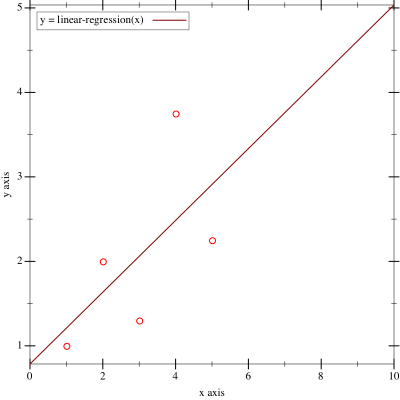
Cool, right?

 bor0's reflective blog
One thought on “Predicting values with linear regression”