This post assumes knowledge in mathematical logic and algebra.
We will stick to sequences for simplicity, but the same reasoning can be extended to functions. For sequences we have one direction: infinity.
Informally, to take the limit of something as it approaches infinity is to determine its eventual value at infinity (even though it may not ever reach it).
As an example, consider the sequence 
Note that 
If we look at its graph, it might look something like this:
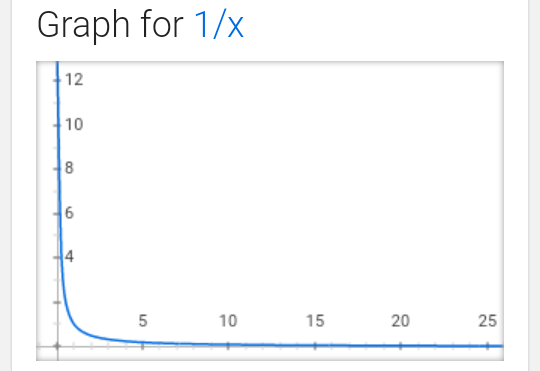
We can clearly see a trend that as x -> infinity, 1/x tries to “touch” the horizontal axis, i.e. is equal to 0. We write this as such: 
Formally, to say that 

It looks scary but it’s actually quite simple. Epsilon is a range, N is usually a member that starts to belong in that range, and the absolute value part says that all values after that N belong in this range.
So for all ranges we can find a number such that all elements after that number belong in this range.
Why does this definition work? It’s because when the range is too small, all elements after N belong in it, i.e. the values of the sequence converge to it endlessly.
As an example, let’s prove that
Suppose Epsilon is arbitrary. Let’s try to pick N s.t. 
Let’s see how it looks for 


This bit combined with the slope point formula form the derivative of a function, which will be covered in the next post.

 bor0's reflective blog
One thought on “Definition of the mathematical limit”