According to Wikipedia, the bisection method in mathematics is a root-finding method that repeatedly bisects an interval and then selects a subinterval in which a root must lie for further processing. We can use this method to find zeroes of some continuous function.
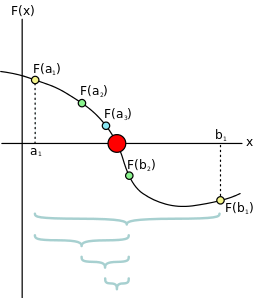
Finding zeroes of a function is a very useful concept in practice. Since the function can be almost anything, this means that we can solve about any equality.
For a given continuous function 


The algorithm is as follows:
- Set interval
- Calculate
- If
is sufficiently small, stop
- Else if
, then set
- Else, set
- If
- Goto 1


As always, definitions are best understood with examples, so we’ll give a few examples.
Example 1: Approximating square root
We will start by approximating the value of 


Let's apply the algorithm a few times now:
| a | b |  |
| 2 | 4 |  |
| 2 | 3 |  |
| 2 | 2.5 |  |
| 2 | 2.25 |  |
| 2.125 | 2.25 |  |
| 2.1875 | 2.25 |  |
So, 2.21875 is a close approximation of 
Example 2: Finding a bad commit in a sequence of commits
As a second example, let’s imagine a function that will represent a bunch of Git commits, where one of the commits are bad. Let’s pick such a function at random, maybe 
How will you find the bad commit? Brute-force or linear search is one way, but it may not be as efficient as bisecting. You can graph the function and look at its zeroes, but that’s a bit cheating, and usually impossible to do in practice with git-bisect since we cannot cover all predicates 
Let’s start at random, knowing at least one good and one bad commit. Maybe picking the interval 

Our task is to find which commit caused the software to break. Let's apply the same algorithm.
| a | b | |
| 50 | 10 |  |
| 50 | 30 |  |
| 40 | 30 |  |
So, in just 3 steps we found that the bad commit was 35.
Git-bisect
git-bisect is a very useful command. Given a sequence of commits, it allows you to find a commit that satisfies some property.
The way bisect works is that it will find zeroes of the function 


The fastest way to do that is to use bisection, which we explained earlier. Git uses good and bad for bisecting left and right.
For example, let’s assume we have the following setup:
bor0@boro:~$ git init
Initialized empty Git repository in /Users/bor0/.git/
bor0@boro:~$ echo "Hello World!" > test.txt
bor0@boro:~$ git add test.txt && git commit -m "First commit"
[master (root-commit) faf3b15] First commit
 1 file changed, 1 insertion(+)
 create mode 100644 test.txt
bor0@boro:~$ echo "Hello Worldd!" >> test.txt
bor0@boro:~$ git add test.txt && git commit -m "Second commit"
[master c9b527b] Second commit
 1 file changed, 1 insertion(+)
bor0@boro:~$ echo "Hello World!" >> test.txt
bor0@boro:~$ git add test.txt && git commit -m "Third commit"
[master 8d28e4a] Third commit
 1 file changed, 1 insertion(+)
Now, if we check the contents of the file:
bor0@boro:~$ cat test.txt
Hello World!
Hello Worldd!
Hello World!
For the sake of this demo, let’s assume the the only acceptable string in a list of strings is “Hello World!”. So the latest commit is now broken. In order to find which commit broke this, we can use bisect as follows:
bor0@boro:~$ git bisect start
bor0@boro:~$ git bisect bad 8d28e4a
bor0@boro:~$ git bisect good faf3b15
Bisecting: 0 revisions left to test after this (roughly 0 steps)
[c9b527bbd44542fb7d69df15ce82919055b36578] Second commit
bor0@boro:~$ cat test.txt
Hello World!
Hello Worldd!
bor0@boro:~$ git bisect bad
c9b527bbd44542fb7d69df15ce82919055b36578 is the first bad commit
commit c9b527bbd44542fb7d69df15ce82919055b36578
Author: Boro Sitnikovski <buritomath@gmail.com>
Date:   Sun Oct 21 20:10:44 2018 +0200

    Second commit

:100644 100644 980a0d5f19a64b4b30a87d4206aade58726b60e3 0c5b693e0f16f325e967f6482d4f9fe02159472b M	test.txt
bor0@boro:~$
It was easy in this case, since we had 3 commits. But if you had 1000 commits, it would only take about 10 good or bad choices, which is cool.
So our property was 

git bisect) returned c9b527bbd44542fb7d69df15ce82919055b36578, the first commit where the property was satisfied.
As a conclusion, it’s interesting to think that we’re actually finding a zero of a function when we use git-bisect 🙂
Bonus: Example implementation in Scheme:
(define (bisect f iterations low high)
  (letrec ([approx (/ (+ low high) 2)]
           [computed (f approx)])
    (cond ((zero? iterations) approx)
          ((> computed 0) (bisect f (- iterations 1) low approx))
          (else (bisect f (- iterations 1) approx high)))))
Interacting with it:
> (bisect (lambda (x) (- (* x x) 5)) 50 2.0 4)
2.236067977499789

 bor0's reflective blog
One thought on “Mathematical structure of `git-bisect`”