Saw this book at a local store and decided to buy it. There are 10 chapters, each accompanied by meditation exercises. It was interesting to see how for some of those, I had already spent a lot of time and reached the same conclusions myself.
Continue reading “A Guide to Becoming Your Own Therapist overview”Year: 2023
Beyond Software Engineering
My team lead once asked me a very simple question – “How does Boro compare today, to Boro a few years ago”?
(One of the things that a person should practice is applying the Socratic method. By asking questions like the one above, people usually get into thinking mode (like myself in this case), and they write/do stuff based on the question 🙂 Most folks in my current team have mastered the Socratic method.)
My answer was brief; working on the full-time hiring team was the biggest contributor. However, one day while I was driving*, I thought of a bit more general question: “How does one go beyond software engineering?”, put a little bit more thought into that question, and I want to share my thoughts here.
* We can debate whether the Socratic method triggered this or it was random 🙂
Continue reading “Beyond Software Engineering”First talk on DevEx & DevRel
At the WordPress 31st Skopje Meetup, my friend and I presented on the topic of DevEx & DevRel.
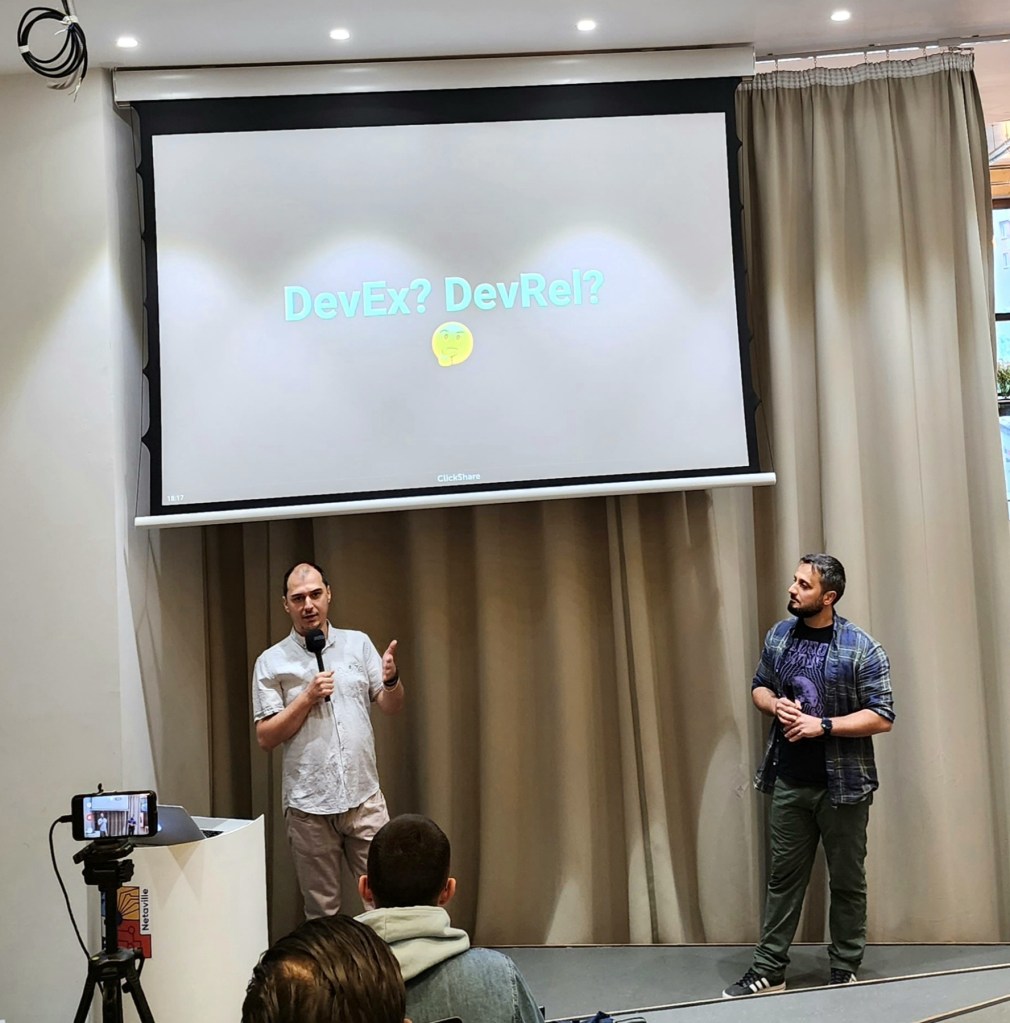
Here is a brief summary of some of the stuff we talked about:
- There is no single definition of DevEx/DevRel. Our take is that it’s like a tourist guide that spreads the word (company culture) across.
- It can be seen as an engineering intersection with one or more of {HR, Marketing, Product, Community, Content}
- The three pillars Product+Community+Content are useful fictions and a lot of stuff overlaps between these
- Community: meetups, conferences, workshops, hiring, mentorship…
- Content: blogging, documentation, tutorials, podcasts, talks…
- Product: coding examples, integrations, collecting and applying feedback, tooling, processes…
- Developers by nature are skeptical folks * – we can achieve much more by doing “indirect marketing” (things such as mentorship, bottle pickup, content writing, etc.) with the hope they follow along and improve – more specifically, they see “by example” why some things are useful doing and they eventually start doing it themselves. This approach is in contrast with e.g. “let’s actively teach you [X] so that you will be better at [Y]”, where I think this will repel more than attract.
- DevEx exists because of the intersectional voids between engineering and [X]. Building relations/partnerships helps fill these voids.
- Measure success in terms of lifetime value rather than OKRs – you can measure how many fishes someone fished but you can’t really measure how you taught someone to fish.
- Why DevEx/mentorship: Third perspective argument – developers get easily stuck in a cycle when programming (focused work) and it is easy to “forget” the big picture.
* This argument is of the form “Everybody is a skeptic” – you either agree with it, or you don’t, which proves the point in any case. One can argue it’s an unfair argument 🙂
Goodbye KDP, hello Apress
In 2018 I self-published my first book (Gentle Introduction to Dependent Types with Idris) using Leanpub and KDP (Amazon CreateSpace at the time). I blogged about that here.
In this blog post, I will write about moving away from KDP and publishing with a more normal publisher.
Continue reading “Goodbye KDP, hello Apress”Philosophy and critical thinking overview
I recently completed Philosophy and Critical Thinking (Syllabus), an edX course. The course took about 2 weeks, on and off. This is my second course in philosophy, and my earlier writing on a previous course can be found here.
The course contains 6 modules in total. The format is, for each module there are submodules, and most submodules have text that explains the ideas, accompanied by videos that are a distilled version of the text. Finally, each module includes a graded quiz. The course intertwines philosophy (philosophical ideas i.e. who said what at some point) and critical thinking (logic).
(Meta) The way I consumed the contents:
- Skimming through the texts, including ChatGPT section summaries (this was particularly useful)
- Watching all videos
- Taking notes (thus this blog post)
(Meta Meta) Talking about the way I consumed the content gives more information about what my actions might have been during the course 🙂
In this blog post, I will briefly overview the ideas being discussed.
Continue reading “Philosophy and critical thinking overview” bor0's reflective blog