A coworker recommended this 1976 book to me, and it turned out to be an amazing read! It’s short and compact, and I finished it in a few sittings. While I was already familiar with most of the ideas, I was impressed by how simply (and honestly) they were presented. I guess the author applied the concepts in the writing itself 🙂
In this blog post, I’ll share some snippets and key highlights that stood out to me.
Goals for me
Making contact is not about winning arguments or achieving happiness but about honest communication and addressing personal concerns. It involves maintaining integrity, nurturing self-esteem, and building stronger relationships with oneself and others. Developing this wisdom is a lifelong journey that requires patience and self-awareness, with knowing oneself and connecting with others being essential to this process.
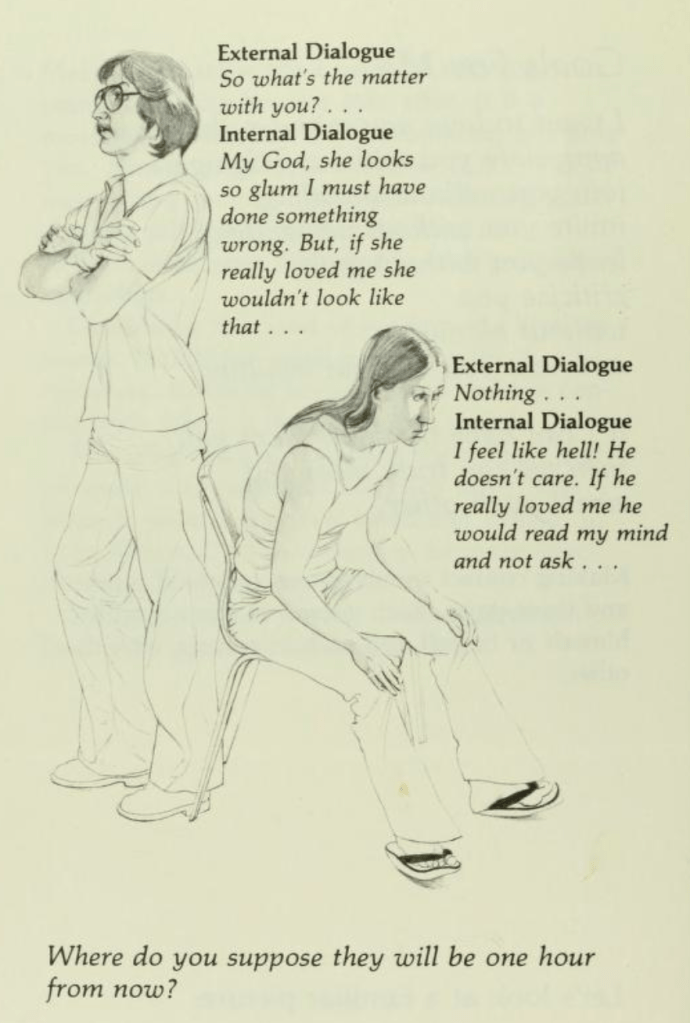
These people are meeting the masks of each other. Masks are not needed – honesty is all that’s needed. Contact has a better chance of being made facing each other at eye level and arm’s length, and talking straight (congruent).
Most of the time, when we communicate we do it habitually. Familiar habits often go unnoticed and feel automatic. People frequently say, “That’s just how I am,” making it difficult to recognize or change, even when those habits cause pain or problems.
The Five Freedoms
- The freedom to see and hear what is here instead of what should be, was, or will be.
- The freedom to say what one feels and thinks, instead of what one should.
- The freedom to feel what one feels, instead of what one ought.
- The freedom to ask for what one wants, instead of always waiting for permission.
- The freedom to take risks in one’s own behalf, instead of choosing to be only “secure” and not rocking the boat.
Congruence
Changing is a matter of being honest with yourself. Four directions to look at when considering a change:
- How do I feel about myself? (Self-esteem)
- How do I get my meaning across to others? (Communication)
- How do I treat my feelings?
- Do I own them or put them on someone else?
- Do I act as though I have feelings that I do not or that I have feelings that I really don’t have? (Rules)
- How do I react to doing things that are new and different? (Taking risks)
Change one part and another one or two go out of balance. Sometimes people feel afraid when this happens. All that it means is that you have disturbed the old balance and you have new balancing to do.
Communication is the giving and receiving of meaning between any two people. What meaning is made? How is it received/given?
Communication is to relationship what breathing is to maintaining life.
Everybody communicates and breathes, but in what ways are they doing it?
The power in congruence comes through the connectedness of your words matching your feelings, your body and facial expressions matching your words, and your actions fitting all.
Discovering old rules
Most of the behavioral rules are learned at an early age, and then become habits. We default to follow these rules (e.g., avoid conflict with parents). Constantly abiding by these rules can cause frustration, but we have the power to transform them.
In the following example, each transformation represents a stage of risk and a new learning.
Never argue with your elders.
-> I must never argue with my elders.
-> I can never argue with my elders.
-> I can sometimes argue with my elders.
-> I can sometimes argue with my elders when I have a difference of opinion.
-> I can argue with my elders when I have a difference of opinion and when I choose to.
Living the catastrophic expectation
Be aware of, and control negative fantasies.
My past
Past experience is a powerful force, but it is not true that we cannot change our present or our future. A question to ask oneself: Is my past illuminating my present or contaminating it?
Becoming acquainted with trigger words
We all have trigger words. The same word can mean different things to different people. Find out what those words are for you and for the people around you.
Making assumptions
When making assumptions, it’s important to check what the other person hears. Even though that may be a bit tedious, when assumptions are shared, misunderstandings are cleared. Many misunderstandings between people occur because of simple human behaviors.
What I don’t hear, I make up, and I hold you responsible for it.
Just like fingerprints, every person is biologically distinct, yet physically similar enough (e.g. organs can be found in similar places). Thus, every encounter with another person involves both sameness and difference. Recognizing these differences as natural human facts, rather than basing reactions on love or fear, allows us to approach relationships as opportunities for exploration and understanding, even with those closest to us.
The key to the presence of sameness and differentness is appreciation, and the means to make it a real-life symphony is congruent communication.
Checking my awareness
While others perceive us through our outward appearance and voice, we tend to judge ourselves based on our internal feelings. We often aren’t aware of how we appear or sound in the moment, but others are, and they form impressions based on these external cues.
Do you know how your face looks right now? Do you know how your voice sounds at this moment? You probably don’t, but everyone looking at you and hearing you does. They take their cues, their mind reading, from your outsides. You are judging by your insides.
You own all the tools you need
A whole contact (congruence) involves maintaining in harmony all of our breath, body, facial expressions, senses, voice, gestures, words, feelings, past experience, ability to move, other people.
This depends on knowledge of how the tools work, awareness of how and when we use them, patience while we are learning and practice for greater skill. Most people, during childhood, were taught to obey and perform tasks competently, but rarely learned how to use personal skills to connect with others and themselves. While obedience and competence are useful, they don’t fulfill all human needs for meaningful contact and self-awareness.
Using the senses
Few people have had instructions on how to fully use their senses.
- Seeing. Because of what we’ve been taught as children, we might avoid “seeing” some stuff as they are. If we don’t look, we make it up. Better to be the recipient of what was actually seen than to make things up.
- Touching. Similarly to seeing. Many taboos against touching. Hands aren’t only for work, punishment, and sex.
- Hearing/Listening. Rather than occupying yourself with things like “what should I say next, how do I respond” and only hearing fragments, focus on listening to the whole story.
- Breathing. Many people are unaware that they’re breathing shallowly and unevenly. Give real attention to your breath.
Paying attention to words
We receive input from the senses (hear something, see something, touch something, etc.) then our brain tries to make sense of it, the sense creates a feeling, activates the joy/panic button, and guides us on what to do next. Being aware of this process and how we use words to formulate it is important for communication. Listen to what you say and see if you really say what you mean. Use these words with caution:
- I (most people mix it with You). “I am saying that the moon is red” (This is _your_ picture) vs “The moon is red” (You’re adding a new law). Take ownership – “It is my picture that …”
- You. “You are making things worse” vs “I think you are making things worse”
- They. Indirect “You”, or spreading gossip. Who is your “they”?
- It. Similarly, the more clear your “it” is, the less the hearer fills it with their meaning.
- But. “I love you but X” are two separate statements. Be explicit.
- Yes, No. These should be stated as clearly as possible, and they mean “now”, not “forever”.
- Always, Never. “Always clean up your plate” vs “Never leave anything on your plate” positive negative. Statements that contain these words are frequently untrue, without any meaning. Careful with making such statements.
- Should. Trap word, accusation, you have somehow failed to measure up. Instead of “I like X but I should get Y”, saying “I like X and I like Y” is better.
For many people talking is a matter of habit…
When something becomes a habit we stop paying attention to it. Making contact with ourselves is finding ways to let ourselves know what we’re doing.
Once something is recognized (“Yes I see it”) and owned (“Yes I do it”), one has a picture of a new possibility (“I see how it could be better”), and then change can begin.
Make yourself an explorer.
Channels
Eyes: seeing one another. Ears: hearing one another. Mouth: talking. Skin: touching. Nose: smelling. If all my channels are working, I hear something full and round, instead of filling it up. Smaller chance to feel misheard or misunderstood.
When making a search, ask yourself the question, “What did I see and hear, and what thoughts and feelings did I then have?”
Share this with the other person and ask that person to do likewise.
Just because I appear to be looking and listening to you, this is no guarantee that I am.
Accepting your Five Freedoms can help you have the courage to take the risks. Using words that clearly show your ownership will minimize the consequences of the risks.
A little summary…
Be INVITING (I have something to tell you, can you listen now?). ARRANGE yourself in a physical position to be at eye level, arm length. BE PREPARED to take risks for bringing your insides outside. MAKE YOUR STATEMENTS with “I”; “I am angry” instead of “You make me angry”. ASK QUESTIONS, get information you don’t have. THINKING.
I wish you Godspeed and above all be loving to yourself.

 bor0's reflective blog