While buying some groceries during this weekend, I noticed this book and as I quickly skimmed through it, I knew it was worth buying it.
In this blog post, I’ll include parts of the book that I found relatable.
Introduction
The author starts the book with:
This is not a book to be read from cover to cover and then put away. Live with it, pick it up frequently, and, more importantly, put it down frequently, or spend more time holding it than reading it.
He also mentions that the book will not provide you with any existing knowledge or give you food for thought, since you already have everything you need in yourself:
The only function of such a teacher is to help you remove that which separates you from the truth of who you already are and what you already know in the depth of your being.
His idea for the book is for it to contain powerful pointers to the truth in the form of aphorisms (short sayings), with very little conceptual elaboration. Aphorisms can provide a good balance between thinking and awareing – the longer the text, the longer one has to compute/think.
Based on the intro, I can see the author’s sources of inspiration for the book. It is funny because I also started writing a short book last year (during my DevEx work) and had a very similar intro and approach.
The thoughts within this book don’t say, “Look at me,” but “Look beyond me.”
While it has many similarities, Gestalt Therapy is active, interpersonal, and responsibility-driven, while Stillness Speaks is passive, introspective, and surrender-based. Gestalt sees change as self-directed and experiential, while Stillness Speaks sees transformation as a natural byproduct of presence.
Chapter 1
Whenever there is some silence around you — listen to it. That means just notice it. Pay attention to it. Listening to silence awakens the dimension of stillness within yourself, because it is only through stillness that you can be aware of silence. See that in the moment of noticing the silence around you, you are not thinking. You are aware, but not thinking.
Meditated on the following and concluded that there are human developmental patterns, just like there are tree developmental patterns. We are no less or no more important than the trees.
When you look at a tree and perceive its stillness, you become still yourself. You connect with it at a very deep level. You feel a oneness with whatever you perceive in and through stillness. Feeling the oneness of yourself with all things is true love.
You can become aware of awareness as the background to all your sense perceptions, all your thinking. Becoming aware of awareness is the arising of inner stillness.
Just look and just listen. No more is needed. Being still, looking, and listening activates the non-conceptual intelligence within you. Let stillness direct your words and actions.
Pay attention to the gap — the gap between two thoughts, the brief, silent space between words in a conversation, between the notes of a piano or flute, or the gap between the in-breath and out-breath. When you pay attention to those gaps, awareness of “something” becomes — just awareness.
When you look at a tree or a human being in stillness, who is looking? Something deeper than the person. Consciousness is looking at its creation. In the Bible, it says that God created the world and saw that it was good. That is what you see when you look from stillness without thought.
Chapter 2
The human condition: lost in thought
If you can recognize, even occasionally, the thoughts that go through your mind as simply thoughts, if you can witness your own mental-emotional reactive patterns as they happen, then that dimension is already emerging in you as the awareness in which thoughts and emotions happen — the timeless inner space in which the content of your life unfolds.
The mind, driven by the need to understand and control, mistakes its viewpoints for truth, fragmenting reality into concepts, yet true awareness arises when one sees thought as just a tool rather than the entirety of consciousness.
The deep knowing that is wisdom arises through the simple act of giving someone or something your full attention. Attention is primordial intelligence, consciousness itself. It joins the perceiver and the perceived in a unifying field of awareness. It is the healer of separation.
Whenever you are immersed in compulsive thinking, you are avoiding what is. You don’t want to be where you are. Here, Now.
Dogmas arise from the illusion that thought can capture reality, creating conceptual prisons that provide false security, yet all eventually crumble as reality reveals their falseness—rooted in the delusion of identifying with thought.
You can stay bored and restless and observe what it feels like to be bored and restless. As you bring awareness to the feeling, there is suddenly some space and stillness around it.
Prejudice arises from identifying with the mind, reducing a living human to a mere concept, which is itself a form of violence.
It doesn’t mean not to think anymore, but simply not to be completely identified with thought, possessed by thought.
By feeling the energy within your body—the life living your hands, feet, abdomen, and chest—mental noise naturally slows or ceases.
Become at ease with the state of “not knowing.” This takes you beyond mind because the mind is always trying to conclude and interpret. It is afraid of not knowing.
Chapter 3
The mind is incessantly looking not only for food for thought; it is looking for food for its identity, its sense of self. This is how the ego comes into existence and continuously re-creates itself.
When you think or speak about yourself, when you say, “I,” what you usually refer to is “me and my story.” This is the “I” of your likes and dislikes, fears and desires, the “I” that is never satisfied for long. It is a mind-made sense of who you are, conditioned by the past and seeking to find its fulfillment in the future. Can you see that this “I” is fleeting, a temporary formation, like a wave pattern on the surface of the water? Who is it that sees this? Who is it that is aware of the fleetingness of your physical and psychological form? I Am.
When you recognize that there is a voice in your head that pretends to be you and never stops speaking, you are awakening… Knowing yourself as the awareness behind your voice is freedom.
By giving your full attention to this moment, an intelligence far greater than the egoic mind enters your life.
When you give more attention to the doing than to the future result that you want to achieve through it, you break the old egoic conditioning.
Almost every ego contains at least an element of what we might call “victim identity.” See what you are doing to yourself, or rather what your mind is doing to you. Feel the emotional attachment you have to your victim story and become aware of the compulsion to think or talk about it. Be there as the witnessing presence of your inner state. You don’t have to do anything. With awareness comes transformation and freedom.
The ego is fed by creating a false sense of superiority, by “righting” itself and making others “wrong”. Can you observe those patterns within yourself and recognize the ego’s voice for what it is? The ego needs to be in conflict with something or someone.In your dealings with people, can you detect subtle feelings of either superiority or inferiority toward them? You are looking at the ego, which lives through comparison.
Jesus’ words, “Forgive them for they know not what they do,” also apply to yourself.
Set goals, but let the fulfillment come from the present moment, not from achieving them, as true satisfaction arises from presence, not egoic striving.
Chapter 4
The division of life into past, present, and future is mind-made and ultimately illusory. Past and future are thought forms, mental abstractions. The past can only be remembered Now. What you remember is an event that took place in the Now, and you remember it Now. The future, when it comes, is the Now.
To have your attention in the Now is not a denial of what is needed in your life. It is recognizing what is primary. Then you can deal with what is secondary with great ease. It is not saying, “I’m not dealing with things anymore because there is only the Now.” No. Find what is primary first, and make the Now into your friend, not your enemy.
Feel the aliveness within your body. That anchors you in the Now.
Taking full responsibility for life means embracing the present moment as it is, recognizing that all things are interconnected and that the form of Now arises from the totality of existence.
Most people confuse the Now with what happens in the Now, but that’s not what it is. The Now is deeper than what happens in it. It is the space in which it happens. So do not confuse the content of this moment with the Now. The Now is deeper than any content that arises in it.
Stepping into the Now frees one from the grip of constant thinking and reveals awareness beyond thought.
I am not my thoughts, emotions, sense perceptions, and experiences. I am not the content of my life. I am Life. I am the space in which all things happen. I am consciousness. I am the Now. I Am.
Chapter 5
Peace is found by realizing who one is at the deepest level, and who one is at the deepest level is inseparable from the Now.
When you don’t know who you are, you create a mind-made self as a substitute for your beautiful divine being and cling to that fearful and needy self. Protecting and enhancing that false sense of self then becomes your primary motivating force.
One does not have a life, one is life. Only a mind-made self can “have” something.
As you go about your life, can you be aware of yourself as the awareness in which the entire content of your life unfolds?
That is, you are not somebody who is aware, you are awareness itself. Can you integrate this? When you know yourself as pure consciousness, experiences are no longer filtered through the screen of past concepts—perception becomes clear, and awareness recognizes itself.
Freedom arises when you realize yourself as the awareness beyond phenomena, allowing life to unfold with lightness, playfulness.
Chapter 6
Do you really need to mentally label every sense perception and experience? Or is that just a deep-seated mental habit that can be broken?
Doing one thing at a time means to be total in what you do, to give it your complete attention. This is surrendered action — empowered action.
When you accept the fleeting nature of experiences and stop seeking lasting fulfillment from the world, you free yourself from egoic wants and fears, allowing life to unfold with peace and harmony.
Do you know of someone whose main function in life seems to be to make themselves and others miserable, to spread unhappiness? Forgive them, for they too are part of the awakening of humanity.
Stop identifying with thoughts and emotions and instead become the awareness that observes them.
Chapter 7
To bring your attention to a stone, a tree, or an animal does not mean to think about it, but simply to perceive it, to hold it in your awareness. You sense how deeply it rests in Being — completely at one with what it is and where it is. In realizing this, you too come to a place of rest deep within yourself.
Immerse yourself fully in nature’s presence—be still, observe, and listen—where every being exists as itself, unburdened by self-image, revealing the oneness that dissolves the illusion of separateness.
You didn’t create your body, nor are you able to control the body’s functions. An intelligence greater than the human mind is at work. It is the same intelligence that sustains all of nature. You cannot get any closer to that intelligence than by being aware of your own inner energy field
A dog’s pure joy, unconditional love, and presence in the moment contrast with its owner’s often burdened mind, raising the question: how does the dog stay so effortlessly sane and happy?
Notice how present a flower is, how surrendered to life.
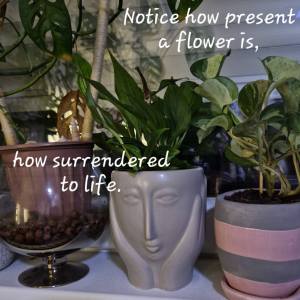
You need nature as your teacher to help you reconnect with Being. But not only do you need nature, it also needs you. Through your recognition, your awareness, nature too comes to know itself. It comes to know its own beauty and sacredness through you!
Chapter 8
Judging others by their conditioned behavior creates a false identity that traps both them and yourself, while recognizing behavior—without attaching identity—frees you from ego-driven relationships.
When the ego controls you, relationships are driven by desire and fear, but focusing on the present moment frees you from using others for self-enhancement.
How wonderful to go beyond wanting and fearing in your relationships. Love does not want or fear anything.
If her past were your past, her pain your pain, her level of consciousness your level of consciousness, you would think and act exactly as she does. With this realization comes forgiveness, compassion, peace
When you receive whoever comes into the space of Now as a noble guest, when you allow each person to be as they are, they begin to change.
True connection doesn’t rely on knowing someone’s story, but knowing them on a deeper, non-conceptual understanding. When we drop mental labels, barriers fall and love naturally flows. Knowing about X has a form, and while it can be practical to understand their thoughts, behaviours, etc. knowing X is formless and is pure love.
Most human interactions are confined to the exchange of words — the realm of thought. It is essential to bring some stillness, particularly into your close relationships. […] Stillness cannot and need not be created. Just be receptive to the stillness that is already there, but is usually obscured by mental noise. […] If spacious stillness is missing, the relationship will be dominated by the mind.
True listening transcends mere auditory perception; it creates a space of presence beyond thought, where words become secondary. Unlike the usual tendency to think, evaluate, or prepare a response, true listening arises from alert attention, dissolving separateness and uniting both listener and speaker in shared awareness.
Human interaction can be hell. Or it can be a great spiritual practice.
How can you free yourself from this deep-seated unconscious identification that creates so much misery in your life? Become aware of it.
Love and beauty are reflections of your true essence; when you deeply feel them, recognize that they arise from within and remain inseparable from who you are, even as outer forms fade.
When there is self-identification with things, you don’t appreciate them for what they are because you are looking for yourself in them. When you appreciate an object for what it is, when you acknowledge its being without mental projection, you cannot not feel grateful for its existence. Through selfless appreciation of the realm of things, the world around you will come alive in ways that you cannot even begin to comprehend with the mind.
A moment of true attention allows the unconditioned essence beneath roles and identities to emerge, revealing that in every encounter, you are ultimately meeting yourself.
Whenever you meet anyone, no matter how briefly, do you acknowledge their being by giving them your full attention? Or are you reducing them to a means to an end, a mere function or role? What is the quality of your relationship with the cashier at the supermarket, the parking attendant, the repairman, the “customer”? A moment of attention is enough.
That which emerges through the act of attention is the unconditioned — who you are in your essence, underneath your name and form. You are no longer acting out a script; you become real. When that dimension emerges from within you, it also draws it forth from within the other person.
Chapter 9
There is only the metamorphosis of life forms. What can you learn from this? Death is not the opposite of life. Life has no opposite. The opposite of death is birth. Life is eternal.
It seems unimaginable and frightening that “I” could cease to exist. But you confuse that precious “I” with your name and form and a story associated with it. That “I” is no more than a temporary formation in the field of consciousness.
Chapter 10
“The thoughts I am thinking right now are making me unhappy.” This realization breaks your unconscious identification with those thoughts.
When you are suffering, when you are unhappy, stay totally with what is Now. Unhappiness or problems cannot survive in the Now.
If you miss the plane, drop and break a cup, or slip and fall in the mud, can you refrain from naming the experience as bad or painful? Can you immediately accept the “isness” of that moment?
Go beyond good and bad by refraining from mentally labeling anything as good or bad. When you go beyond the habitual naming, the power of the universe moves through you.
If you are in the habit of creating suffering for yourself, you are probably creating suffering for others too. These unconscious mind patterns tend to come to an end simply by making them conscious, by becoming aware of them as they happen. You cannot be conscious and create suffering for yourself.
A dialogue:
Accept what is.
I truly cannot. I’m agitated and angry about this.
Then accept what is.
Accept that I’m agitated and angry? Accept that I cannot accept?
Yes.Bring acceptance into your nonacceptance. Bring surrender into your nonsurrender. Then see what happens.
The cross is a torture instrument. It stands for the most extreme suffering, limitation, and helplessness a human being can encounter. Then suddenly that human being surrenders, suffers willingly, consciously, expressed through the words, “Not my will but Thy will be done.” At that moment, the cross, the torture instrument, shows its hidden face: it is also a sacred symbol, a symbol for the divine.

 bor0's reflective blog