Recently I read In and Out the Garbage Pail. It’s an unconventional autobiography by Fritz Perls (the father of Gestalt therapy) where he takes the reader on a raw, stream-of-consciousness journey through his life and the development of Gestalt therapy. The book is both a story about his personal growth and a space for him to share his ideas. It is like a mix of a self-therapy session and a memoir – a real hodgepodge. 🙂
One common theme is how critical he is of Freudian psychoanalysis. Perls had a brief meeting with Freud in 1936, which only confirmed for him that he didn’t agree with Freud’s approach. While Freud believed that our past, especially repressed traumas, controls a lot of what we do now, Perls thought differently – he believed in focusing on the present moment, what he called the “here and now”. Instead of analyzing hidden desires and conflicts, Perls focused on helping people connect with their feelings, bodies, and the world around them. He thought Freud’s ideas, like the Oedipus complex or the id, ego, and superego, were too rigid and didn’t really capture how people grow and change. For Perls, it’s not just about looking back at what happened but about living fully in the moment.
Beyond his critiques, Perls offers insights into his personal journey, sharing experiences from his childhood in Berlin, his military service during World War I, and his emigration to South Africa. He reflects on his relationships, including his marriage to Laura Perls, with whom he co-developed Gestalt therapy. These stories provide context to his theoretical perspectives but also reveal his human vulnerabilities.
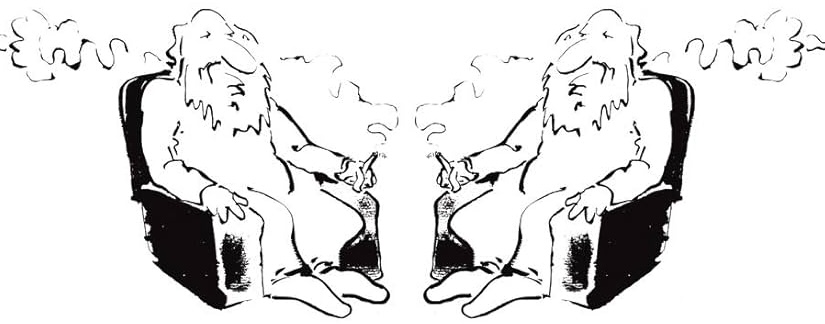
Using anecdotes, poetry, and reflections, Perls shows how Gestalt therapy prioritizes the interplay of mind, body, and environment in shaping behavior and relationships. Applying Gestalt therapy to himself is a common theme in the book.
Topdog: Stop talking about Reich. Follow your intentions and stick to your theme, the oral resistances.
Underdog: Shut up. I told you a few times, this is my book, my confessions, my ruminations, my need to clarify what is obscure to me.
Topdog: Look! Your readers will see you as a senile, loquatious rambler.
Underdog: So, we are back again to my self versus my image. If a reader wants to look over my shoulder, he is welcome, even invited to peep. What’s more, I have been more than once prodded to write my memories.
Topdog: Fritz, you are getting defensive.
Underdog: And you are wasting too much of my and the reader’s time. So sit still and bide your time and let me keep you waiting. Let me be just as I am, and stop your chronic barking.
Topdog: O.K., but I’ll be back again when you will least expect me and you need guidance from your brain: “Computer, please, direct me”
He’s also very aware of his thought processes and continuously reveals those to the readers:
I wish something exciting would come up. Some theory, some poetry, but I am sticking to my promise to write only what comes up. After all, nobody can determine the sequence in which his shit comes out. Yet there is law and order in nature.
Swims against the current 🙂
Right now, quite a few people are crowding into this book, sneering at my letching, despising me for my lack of control, being shocked by my language, admiring me for my courage, confused by the multitude of contradictory features, desperate because they cannot pigeonhole me. I feel tempted to get into a dialogue, but…
(Can’t be pigeonholed -> being inconsistent -> defensive mechanism?)
The book’s content flies from topic to topic, relying on free associations. At the end, the book stops sharply. Rather than feeling irritated about that, one can use it to examine their expectations of book content in general.
In essence, the book is a self-examination, mixing personal experiences with philosophical thoughts. It offers insights of Gestalt therapy and demonstrates Perls’ commitment to self-awareness and authenticity. Through this work, Perls sets the foundation for a therapy that emphasizes life’s immediacy, spontaneity, and wholeness.
Raw notes
(Page numbering based on the Macedonian translation. Notes mostly focus on knowledge/philosophical parts)
p7 Self-actualization vs self-image. A rose is a rose is a rose
p8 Freud stuck at ego, no self-actualization
p9 Polarities are potential for actualization
p10 Abstract, don’t subtract
p12 Fitting and comparing games
p18 Spontaneousness vs rehearsing/preparing
p21 A neurotic is a person who focuses on manipulation rather than self-growth
p24 Psychoanalysis as an illusion for patient improvements
p26 Children are pure and see the obvious, grownup blinden them
p27 Awareness is the end-goal. (Thinking to myself: Be aware of how awareness is a big goal – what do you feel? God. How do you feel?)
p30 The omnipresentness of God is mirroring awareness. Reality is nothing but the sum of all awareness
p34 Science moves from why to how
p36 DMZ = calculations, biases, perfection, compulsion, thoughts, words, …
p37 Organismic regulation > shouldism
p44 Freud appreciation. I don’t agree with Perls that he’s boasting (like he says), it’s more about seeking human connection, and sharing and learning. Perls seems to have felt because he didn’t have a Teacher
p45 Marx puts food, Freud puts libido (life energy and sex) in front. integrate both, equally important
p49 Nature is not so wasteful as to create emotions as a nuisance
p53 Perls’ curiosity
p55 Based on Perls’ life experiences, you can see how he came up with the topdog/superdog (e.g. his almost imaginative relationship with Freud)
p58 Psychoanalysis didn’t help his spirituality and he turned to Humanistic. Take responsibility himself
p59 Talks against concepts yet he still uses the Gestalt concept (wdyt about this paradox?) I think he claims that Gestalts are very natural, they go beyond human idea concept
p61 A Gestalt is an irreducible phenomenon, like an atom
p63 Meaning is a creation in the here and the now, based on the relationship figure/ground (ground is context). Infinite gestalts. Incomplete gestalt = unfinished business
p64 Integrated gestalt = habit, economical by nature
p65 When a gestalt is established, it becomes a part of the organism. To change/reorganize a habit, it needs energy investment. Put in the figure, awareness. Unfinished gestalts block growth
p67 Awareness the hub of gestalt approach, phenomenology (subjective experiences) is primary towards knowing all there is to know
p68 Perls feels inferior to a friend who is unobtrusive and confident, vs his own excitability and primadonna-ishness
p74 Socrates “I know that I don’t know” – how much glory can you give to the intellect? Psychology nowadays = physiology + reason/emotions/willpower/memory. Everything will differentiate into opposites – if you stay in the center (nothingness, zero), you are balanced
p76 We call the zero point “normal”, then we talk about normal temperature, etc.
p77 Any disturbance to this balance forms an incomplete gestalt
p78 “My intermediate zone is less crowded than the average and that I am capable of seeing the obvious”
p81 Learning is a discovery that something is possible
p82 Basic organismic function is the necessity to discover. Behaviorists are like engineers, think of the human as a mechanical device because they ignore awareness
p84 Freud, suffering form systematitis, had to find a common denominator for his model – the libido
p88 Figure/ground, only focus on one event at a time, otherwise confusion
p89 If more than one gestalt emerges, humans get into the decision making game (which usually means avoidance). No decisions are needed, just preferences, as is natural – order over conflict. Foreground and background must be easily interchangeable, otherwise we get a disturbance in the attention system
p90 Excitement and sleep are incompatible
p92 Every therapist is a patient
p109 Contact/withdrawal polarities
p110 All parts of an organism identify with the emerging gestalt. Freud’s introject<->Perls identification
p111 Opposite of identification is alienation. confluence = unclear boundaries, losing touch just to fit in or avoid conflict
p112 Goal of psychoanalysis find hidden treasure. To recover means to own/remove the blocker
p118 Tiredness = signal for withdrawing
p119 Cope is outer zone, withdraw is inner zone. Regression (withdraw) is not neurotic symptom, it’s about recharging and coming back with fresh energy (cope). If there is no cycle, then pathology = chronic cope (fixation, compulsiveness) or chronic withdraw (out of touch, closedness)
p121 “I feel frustrated but I know that I cause this frustration to myself”. In contact with all three zones: inner (beneath skin), middle (fantasies), outer (world). Middle usually stops contact between inner/outer
p122 Dreams, compared to fantasies, are real, spontaneous, coded messages
p128 Neurosis layers: cliches, games & roles, implosion, impasse and explosion, authenticity
p129 Cliches are rigid but ok to experiment for initial contact (hi how are you); games & roles (I’m better than you, child/adult/parent/good person/soft person/etc used for manipulation)
p130 Be aware of who brings toxicity and who brings nourishment in your life. Useful for cope/withdraw. Observe them. What is it that irritates you?
p131 “We are always playing, but only the wise ones know it”
p132 Dybbuk (introjected/copied) is a foreign part in the body
p133 Holes in personalities (no ears/eyes/etc, but most of all, no center)
p134 Replace holes’ empty void (nothing) with fertile void (something). plant seed
p135 Psychoanalysis was a research project. some ppl use suppression as a tool, not a cause
p136 Integrated inner zone + outer zone = focus
p138 Modern man has abstract/concrete polarities. two or more ppl meeting will convert their personal env to a shared env
p139 Each person has unique motivation/needs for completing their gestalts.
p140 A number is highest form of abstraction. Fantasy is as vital to our social existence as gestalt formation is to our biological existence, grounding the “mind” in reality through awareness theory
p141 Common sense = fantasies that match observed facts. Each memory is an abstraction of an event, not the event itself
p142 Recalling memories in the now is different – diff emotions etc. Even the most reliable observation is an abstraction
p143 Perls constructed the idea of a garbage pail to reorient himself
p149 “If you are stuck between the verbal and the non-verbal, then look at your impasse, use your theory”
p150 Figuring stuff about himself: “Topdog: Now Fritz, don’t make me angry. And don’t play the spiteful brat. Underdog: Ha,ha,ha,ha! I got you. I can play teacher, I can play sexpot, but I must not play spiteful brat.”
p151 Behaviorists with their reflexes treat humans as robots
p152 We replace behaviorism with holistic-organismic concept; we scan the space and selectively pick, not in a robotic fashion
p154 Fritz(‘s topdog) to himself: Poor Fritz. If I have time, I’ll feel sorry for you tomorrow.
p158 Organism is a whole – just the way you can selectively choose biochemical, behavioristic, experiental functions, you can also approach it as a whole
p160 Goldstein anxiety comes from catastrophic exp. Freud anxiety comes from trauma and libido repression. Reich/Adler anxiety comes from suppression of aggression. But they all intellectualize
p162 The term excitement is more practical than libido. These emotions transfer to mechanical energy (anger->kicking, etc). Once this energy is fully transformed and experienced, gestalt is closed
p163 Thyroid plays the role of general excitement
p165 Anxiety is the tension between now and later. When we are unsure what roles to play can also cause anxiety. Stage fright is the most common form of anxiety
p166 Self-actualization vs self image as a constant anxiety source. Transforming excitement to emotions and processing them is blocked which contributes to more excitement
p169 Unbalanced left/right is expressed in neurosis, ambidexterity in genius
p172 Freud: one is healthy if one gets rid of anxiety and sense of guilt. Not fully agree with this myself
p173 It feels much nobler to feel guilty than resentful, and it takes more courage to express resentment than guilt. With expressing guilt you expect to pacify your opponent; with expressing resentment you might stir up hostility in him. “I demand that you are here In the now and direct! Passionate and crystal clear!”…
p174 …You just sit there and make impossible demands. You want me to feel guilty if I don’t live up to them. I more than resent you for that, I am furious and I hate you. You are mixing me up like Freud. First you suck me in with: “Just be yourself,” and then: “Just be yourself as / want you to be.”
p175 Guilt is social phenomenon, resentment is organismic
p178 In group therapies everyone pours their opinions to the victim, everyone interprets, shares arguments… the goal of healing is to teach one wipe their ass
p179 If therapists tell the client “you should…” the client will produce fake experience to please the therapist, ending up with bigger neurosis. In this topdog/underdog encounter Perls was easy on him – you can see how much he trusts his opinion
p180 Perls often tests clients to see if they are authentic or just want to please him (body movements, voice, relies on his intuition). If they are authentic the next step is for them to express their requirements explicit, by visualizing
p183 Structure and function are identical: Change a structure and you change its function; change a function and you change its structure.
p189 Stay with Heisenberg’s principle: observed facts change through being observed! Fertile void, speak through me; Let me be in grace; Let a blessed true me; See you face to face.
p191 Asks people to read his book in his presence, to experience their participation. He needs need much affirmation. “If I would exclusively write for myself I would leave out much of the theoretical stuff”
p191 “I am greedy both ways: to have more and more experiences, knowledge and success, and to give all I have”
p196 When talking to someone in a session: “With my suspicion I put a seed in them”. Perls has high attention to detail (noticed few characteristics of a cat) and also experimental spirit (will the cat stay if he does this?)
p197 Topdog/underdog “Yes, I wanted to write about my house and you interfered and put me on the defense again. Ping-pong, ping-pong, ping-pong. Mind-fucking again.”. When he doesn’t “teach”, the reader can notice that he continuously assesses people’s personalities.
p198 “Fritz, you have to learn to discipline yourself.” Stop mind-fucking. Zaebancii se tupadzii, aboutism.
p199 Layers: chickenshit (everyday cliches), bullshit (rationalizing, explanations), elephantshit (philosophizing). aboutism (descriptions, unproductive arguments), shouldism (you should…, why), isism (A rose is a rose is a rose, existentialistic, noone can be different from what they are). ‘Moishe and Abe are playing cards. Moishe: “Abe, you are cheating!!!” Abe: “Yes. I know.” Fritz as an aboutist., a storyteller; Moishe as a shouldist; Abe as isist’
p200 Retroflection diagram (withholding emotions, eating self)
p201 Projection diagram (displacing one’s feelings to others) “I’ll reown you, projection”, “sure, but be careful to not introject”
p202 Introjection diagram (unconsciously copying traits from others) “you have good contents, I’ll assimilate you, I’ll own you”
p203 Self awareness should be called awareness of a critic public. it is the mildest form of paranoia. the speaker imagines a screen and projects his criticality and attention. easy fix: identify the projection, pay attention to reality.
p203/204: Retroflection: self torture, self doubt, self talk. Fix: do unto others what you do to yourself (sufficient to just imagine doing it, or psychodrama)
p206 The healthy I isn’t a combination of introjects, but identification symbol. “cant hear myself while thinking, unless I write it out”. “when split myself topdog/underdog, communication happened. when I roleplay teacher, teaching the reader. when I roleplay attacking Freud, the reader is my witness to my courage”
p208 Got selfmotivated and some consolation from writing a few paragraphs, and then “Or did I play a trick on you and myself by picking out brilliance and evil?”
p210 The message is just a medium, truth is in the sound – are you giving food or poison?
p211 The wisdom of your intellect will enter the heart and you will become truly wise
p212 Intellectual systematitis as a symptom – too much explanations
p216 I am honest with you, though it hurts.
p217 “When I work I am not Fritz Perls. I become nothing, no-thing, a catalyst, and I enjoy my work. I forget myself and surrender to you”; “To work successfully I need a tiny bit of goodwill. I cannot do anything for you, my smart aleck.”
p222 “The existential mood of being ‘condemned to’ life changed into being ‘blessed with’ life.”
p226 To seek pain and make a virtue out of it is one thing, to understand pain and make use of nature’s signal is another. “Pay attention to me. Stop what you are doing. I am the emerging gestalt. Something is wrong. Pay attention!! I hurt.”. Though dying with fright on the hot seat, go through it with the hope of becoming real. Integrating IZ/OZ: “For two days I had no urge to write, […] a number of OZ events had to take priority”
p227 The hot seat characteristics: now & how, take responsibility, phobic behavior
p228 After the psychodrama birth experience, Fritz helped one patient reconnect with their body and the world—filling the emptiness with the start of a fertile void, by identifying the person who drives the patient crazy.
p229 Fantasizing as a time well spent is rewarding enough. Negative fantasies, not so much. Kubie proposed the therapist-teacher-psychologist as an interdisciplinary role that integrates therapy, education, and psychology to foster holistic development, emotional insight, and preventive mental health support in individuals.
p230 The empty seat is used to identify projections
p231 He uses the empty chair technique: “Fritz, I don’t remember any dream material.” Then replies to himself, “You’re lying. You mentioned an attaché case.”. Put the case in the chair. “I’m an attaché case with a thick skin, full of secrets no one can access.”. “Now I am going off stage and you “write a script,” this is my term for changing seats and carrying on a conversation.”
p239 Finishing school in spite of his multiple life – were their struggles a setback, or did the richness of their multifaceted life ultimately shape their success?
p240 Bern’s limited roleplay parent child
p241 Bern contributed adding the role of a child against Freud’s superego, creating polarity. Perls calls them topdog/underdog (e.g. husband vs wife, therapist vs client). These “neverending” battles can be integrated if one becomes aware and starts listening. _under_stand (humility (poniznost)) over _over_stand (staying on top). Fighting is good if it mobilizes one’s potential, It is based on the joy of growing. Fighting is bad if it is mobilized by prejudices
p244 Initial definition of transference: client transfers their feelings onto the therapist. Freud neglects the process with mechanical thinking, does not look holistically
p245 Holistically – the whole organism. Toxic people lack system for proper elimination of toxicity. We don’t yet understand the relation between the organism and personality. When someone feels bad their primary reaction is to project on others (moral is organismic judgment) – similar with conditioning, ego boundaries, education and other phenomena
p246 Behaviorists with their conditioning (punish/reward) transfer their needs as your responsibility “you need to become X!”
p247 Contact is respecting the differences, confluence (blurred boundaries) is respecting the sameness, isolation is judgment of differences
p248 “Will the phonies (masked) take over, or will the real and sincere people survive”
p252 We create a solid foundation for centering ourselves within ourselves. “If the client tries to upset, control, or challenge me, I don’t react. By not trying to control them, I stay in control. If I refuse to engage, they usually come back later, ready to work.”
p253 Do we align with our true self or with others’ expectations? Both extremes can be harmful: focusing only on yourself leads to isolation, while focusing on others means sacrifice and repression. Balance comes from connecting with both yourself and your surroundings, allowing integration.
p254 A solution requires knowing the ego boundary (projections, introjections) and the self boundary (what we can sense, contact with env and retreat when necessary)
p258 Our senses only notice the surface. Focus on what’s obvious, like posture, voice, or movements. Digging too deep leads to endless analysis (peeling onion layers). What matters is already visible if we pay attention and are not blinded by overthinking. The same applies to ego boundaries—stick to simple, surface interactions.
p261 With this book, Perls wants to expose his thought process to us. Freud: no analysis is ever complete. Perls: there is always something to assimilate and integrate. Freud: if one stops repression, integration happens by default. Perls: as long as the insights are not dismissed as merely “interesting”
p263 Ego boundary is the zero point (center) of selfexpression/projection, identification/alienation, known/unknown
p265 His grandfather lived within the family boundaries, while his father outside those boundaries
p266 His early exposure and experiences with the theater: “What kind of people were those actors, who could turn themselves into something different?”
p270 “Every one of us tries to keep the region within the boundary as harmonious and pleasant as possible. In order to do this we have to cleanse the ego.“
p274 Relation between obsession and paranoia. Maya (“as if”) is the opposite of reality. Integrating maya and reality = art
p275 Maya contains fantasies, games, role playing, thinking, the illusions created by the ego, as well as the boundaries
p276 The psychotic (contact maya) says, “I am Abraham Lincoln,” the neurotic (continual fight between ego/self, between delusion/reality) person: “I would like to be like Abraham Lincoln,” the healthy (contact with self and reality) one: “I am what I am.”. Solution: cleanse/filter the delusional system (middle zone, ego, complex) so that the organism can grow and use its innate potential.
p278 The crucial Gestalt question: what are you avoiding?

 bor0's reflective blog