I recently enrolled in an internal coaching workshop at Automattic, the company where I work.
A suggested pre-read was the four chapters of Coaching for Transformation: Pathways to Ignite Personal & Social Change.
I found both the workshop and the book super useful. I will post some notes/snippets for the book’s first four chapters.
Chapter 1
Transformation happens when people are deeply seen, heard, understood and recognized for their gifts. Ironically, when we try to change people, they resist. In contrast, coaching helps people become more of who they already are. Simply witnessing the process and being fully present has a transformational impact. […] Naming what is happening in the moment on a physical, emotional and energetic level amplifies the transformation.
Instead of looking for the big “aha” moment, we notice that transformation can happen in any moment.
The following three quotes made me think of similarities with Gestalt therapy, which I find great!
Lasting, sustainable change is rooted in deep awareness.
Our holistic approach combines awareness of body, mind, soul and spirit with solid coaching skills. As we exercise the right and left brain, we integrate the heart, mind and body with logic and the mystery of transformation.
Consider the power of being in relationship from a place of wholeness, honoring all that is present, while holding the space for all that is yet to be born.
As someone who’s used more to “working solo”, this was a good reminder:
We believe that working together unlocks greater potential than we can achieve on our own
Not specifically related to diversity (more to past egoistic drives), a question that has really helped me here is “Why does this frustrate me?”. It was nice to read a compact version of it:
The more aspects of ourselves that we acknowledge and accept, the more accepting we are of diversity in the external world.
“I choose to” over must/should/have:
When we remember that clients have the freedom to choose their response to circumstances in their lives, we free ourselves from judgment and from taking responsibility for them.
The journey has no fixed destination, but holds great promise and rich rewards.
I found this to be an interesting framing of curiosity:
Curiosity—the opposite of judgment
Coach needs: curiosity (not judgment), compassion (empathic connection), courage (bold, authentic communication)
Client needs: awareness (what is present), alignment (between inner/outer experience), action (moving forward)
Connection comes first. Nothing happens without connection. Fierce love and unconditional support build trust and a flourishing relationship. The coach and client share power equally. This relationship is a space for experimentation, alchemy and human evolution. In every moment, transformation is possible for both the client and the coach. In the space of deep connection, intuition blossoms for both the client and the coach.
Chapter 2
Listening words, content, intonation
Conscious, clear, empathic listening fosters self-awareness and affirms their experience. Examples: Hearing the words of the story and listening for the underlying desires
What can I focus on in the present moment? What are the objects in the field that demand attention? What else is demanding attention that I cannot see?
I can ask a clarifying question, a reflecting one, or a distilling one.
Phil: I am not creating this chapter for the book the way I had hoped.
Coach (clarifying): You are hoping for something more?
Coach (reflecting): So you are not creating what you’d hoped?
Coach (distilling): You want access to your creativity?
Evaluating or analyzing: Instead of interpreting or psychoanalyzing, reflect the content or the emotions and needs. “I noticed you first put others before yourself. How would it feel if you put yourself first?”
Productive interventions:
- Long-windedness: Simple, short interruptions help people self-connect.
- Multi-tasking: Instead of cleaning off your desk and trying to listen at the same time, give 100% attention. Show that you care by suspending all other activities.
- Pretending you understand: If you get confused, say so. “I’m not following you. Could you say that another way?”
- Understating or overstating: If your client expresses mild annoyance, instead of saying, “You sound really angry,” reflect back the same level of intensity and energy. Likewise, if the speaker is loudly expressing outrage, she won’t feel understood if you quietly reflect, “You sound a little annoyed.” Meet her where she is.
Relying on intuition:
- I can hear the complexity of all you’re facing. What does your intuition say about it?
- My instincts tell me you’re in the calm before the storm. Is there anything worth exploring here?
- I’m getting an image of a bear eating honey and ignoring the bee stings. Does that have any meaning for you?
Curiosity:
The wisdom of not knowing allows us to be present to something new unfolding. But what if we do know? Suppose something similar has happened to us and we know exactly what the client should do? Since their experience is unique, we stay curious about what we don’t know.
Found some interesting questions for the question bank. Combining this with faith:
What do you want? How will that get you closer to where you want to be?
To really work through the question, build a dialogue.
We can open our sessions as though we are opening a gift box with a rare gem inside.
The author Mary Rose O’Reilley talks about how listening like a cow helps people establish radical presence. She says, “Cows cock their big brown eyes at you and twitch their ears when you talk. This is a great antidote to the critical listening that goes on in academia, where we listen for the mistake, the flaw in the argument.” Critical listening crushes the spirit and weakens trust. Empathic listening builds awareness and trust and encourages hidden talents.
Leaps of insight, awareness or creativity are spontaneous. When a natural opening presents itself, we can mine the vein of gold. To be in the natural flow, we recognize openings, let go of our agenda, follow our intuition and respond in the moment. For example, a client says she is sick and tired of the same old same old. Rather than trying to find a solution the same old way, the coach hears that new felt sense, interrupts and acknowledges, “What’s the easy way out of being ‘sick and tired’?” If we get an image of the client flying, instead of deliberating the pros and cons, we can respond to that moment by saying, “I see you flying,” which may open the client to a whole new way of seeing life.
Allow your work and your recreation to be one and the same… Serve others and cultivate yourself simultaneously… Understand that true growth comes from meeting and solving the problems of life in a way that is harmonizing to yourself and to others. – Lao Tzu
Since we are always making choices, what is the choice we want to make regarding self-care? The most valuable resources we have as coaches are our health, energy, empathy and clarity of mind.
In my early professional years I was asking the question: How can I treat, or cure, or change this person? Now I would phrase the question in this way: How can I provide a relationship which this person may use for his own personal growth? – Carl Rogers
In the coaching relationship, that anticipation presents as Hope.
The coach sets aside personal opinions and biases to focus on the client’s intrinsic worth. No matter what the client says or does, we interpret it as an expression of an intention of something positive-and we nurture that intention.
When the client trusts the coach, deep explorations can happen.
We create intimacy so that whatever the client shares, we receive it as a precious gift.
Five contracts: self and God, coaching expectations, general outcomes, session agenda, session moment to moment.
Coach stand: set of physical, mental, spiritual qualities (embody when coach)
Physical:
- Walking or pacing
- Scanning the body for sensations
- Opening your eyes widely
Try different postures/movements while coaching, experiment, see the impact on the energy coach/client/relationship.
If we get stuck or the client gets stuck, we move!
Mental/metaphorical:
- Walking along the beach together as co-explorers
- Persisting like a curious child
- Sword cutting through illusion and self-deception
- Looking out from the crow’s nest
How do you develop commitments that enliven and empower you, your client and the relationship? You may already know what commitments you want to develop. If so, experiment with them and discover how they affect your coaching. If not, the first place to look is the core principles.
Examples of empowering, enlivening commitments:
…
I stretch myself for the sake of my clients’ transformational agenda
To enhance your focus on your client, ask yourself:
- What are the untapped resources in my client’s life?
- How am I holding back and forgetting my client’s resourcefulness?
- How is this client already whole and moving toward a greater expression of her wholeness?
- How can I stop problem solving and start trusting my client’s inherent creativity?
Master coaches step past the borders of knowing – greatest value comes from our willingness to be a co-explorer to places that haven’t been explored.
We can be more interested in their ideas and what is possible than in our ideas.
When you come up with a coach stand, make sure you feel the intention/energy of it.
My mentor asked what my coach’s stand was, and when I shared it, she said she didn’t feel any of that intention or energy during the session. In a moment of intuition she said, “As I listen to your coaching I keep getting an image of a flying trapeze.” In that moment something clicked and I saw clearly how my coach’s stand could support me. Since that day the flying trapeze has been my coach’s stand.
Many experienced coaches say that some of their most powerful and inspired sessions happen when they enter the coaching without much emotional or physical energy, but are able to tap into unexpected energy and resourcefulness. Self-focused listening brings us into an awareness of what is happening in the moment and the inner resourcefulness to reconnect to our power.
Once we have developed the three parts of our stand (physical, metaphor, commitment), we use them to call out our clients’ power. Before each coaching session, we focus on our commitment, step into the metaphor and embody the physical component.
Questions to Consider:
- Experiment with your coach’s stand. What stand feels most powerful for you?
- What do you notice as you focus on the three levels of listening in your coaching sessions?
- What do you notice about your sense of presence when you trust your intuition?
- What do you notice about your sense of being present when you get curious?
- How can you give the gift of full presence?
After reading this, I had an inner dialogue with my self for the coaching stand. The things that popped into my mind:
- Mutual growth
- Being fully present
- Using each other’s awarenesses to enlighten “hidden” parts
- Boosting awareness about client’s resourcefulness
- Experiencing
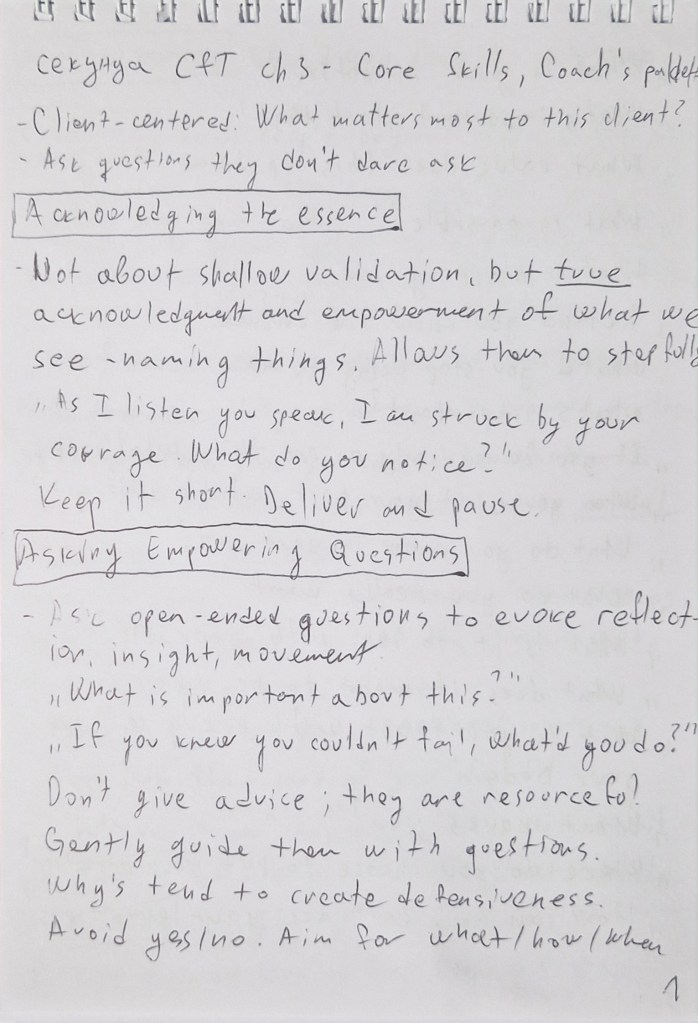
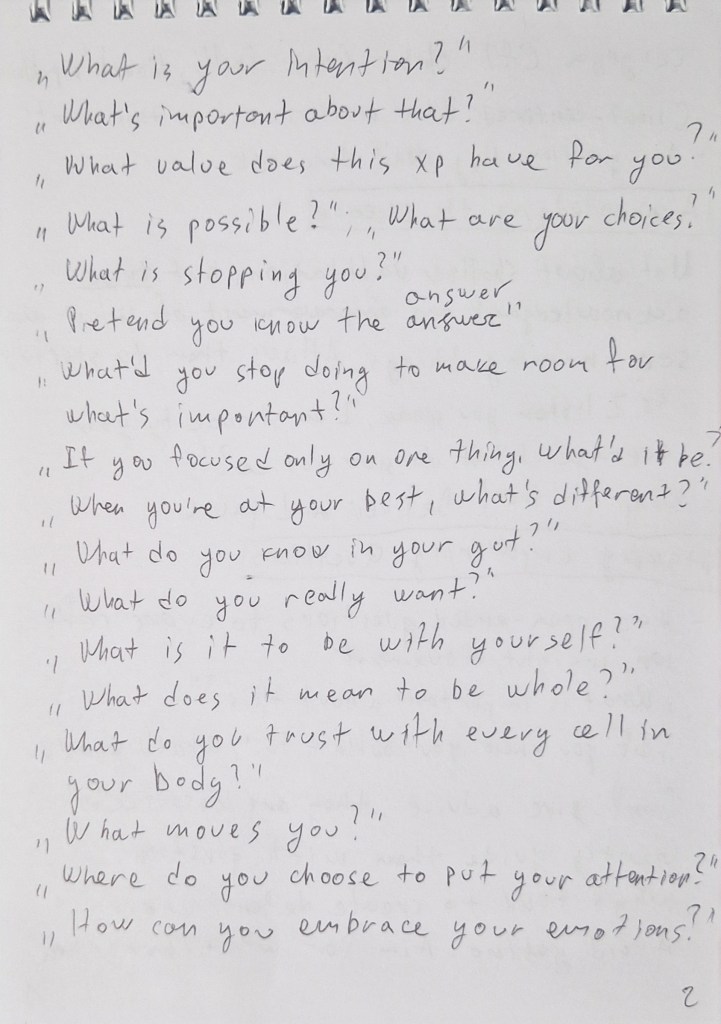
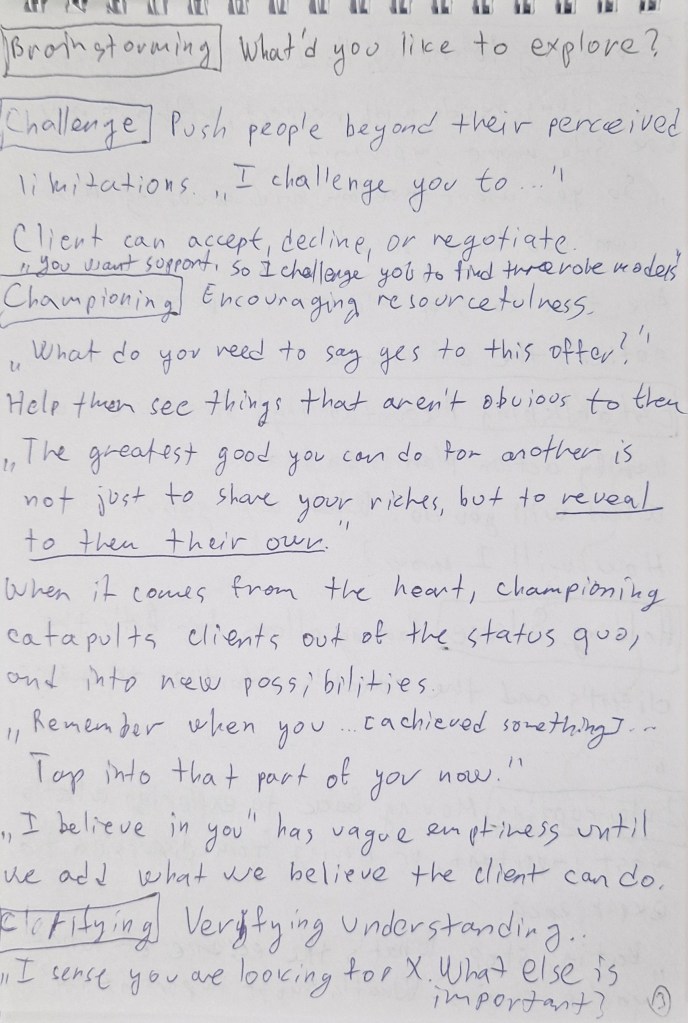
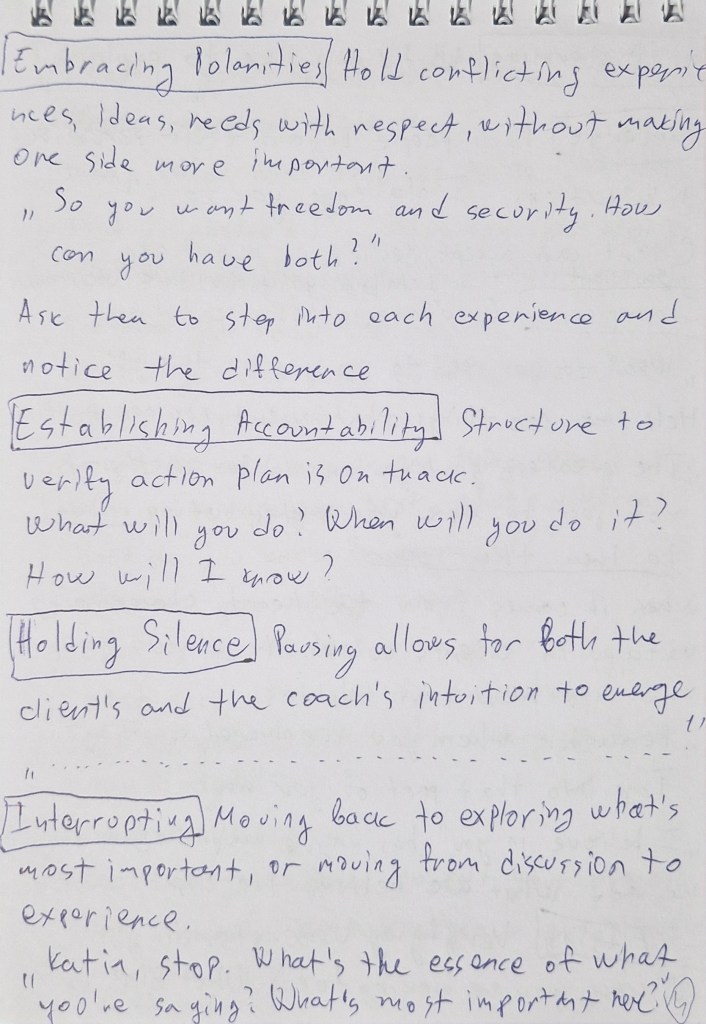
Chapter 3
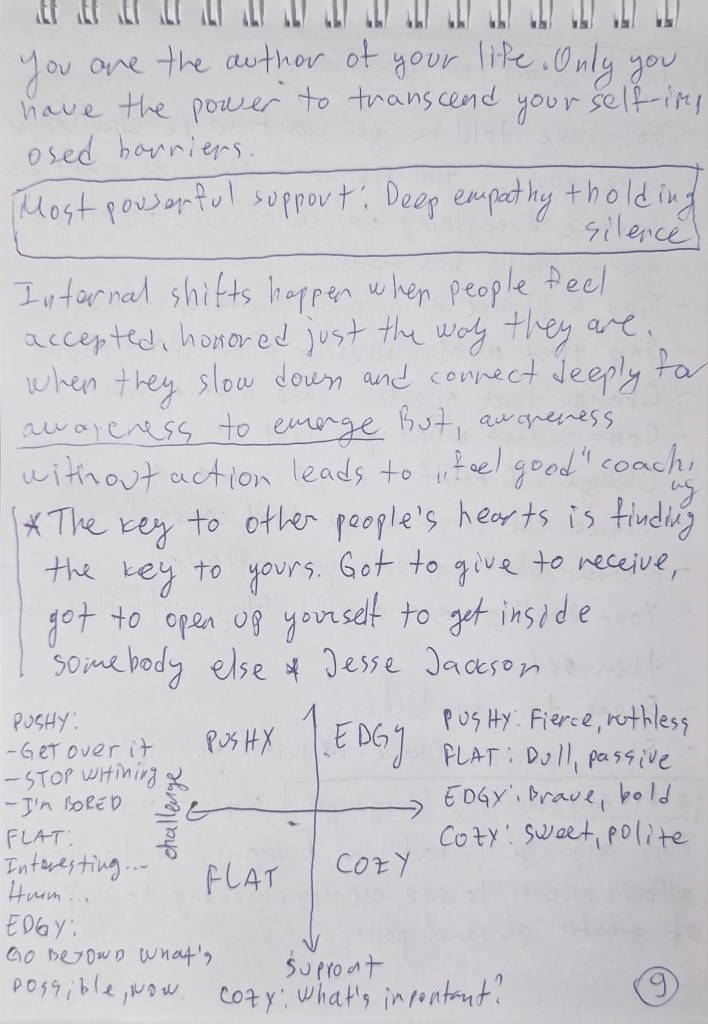
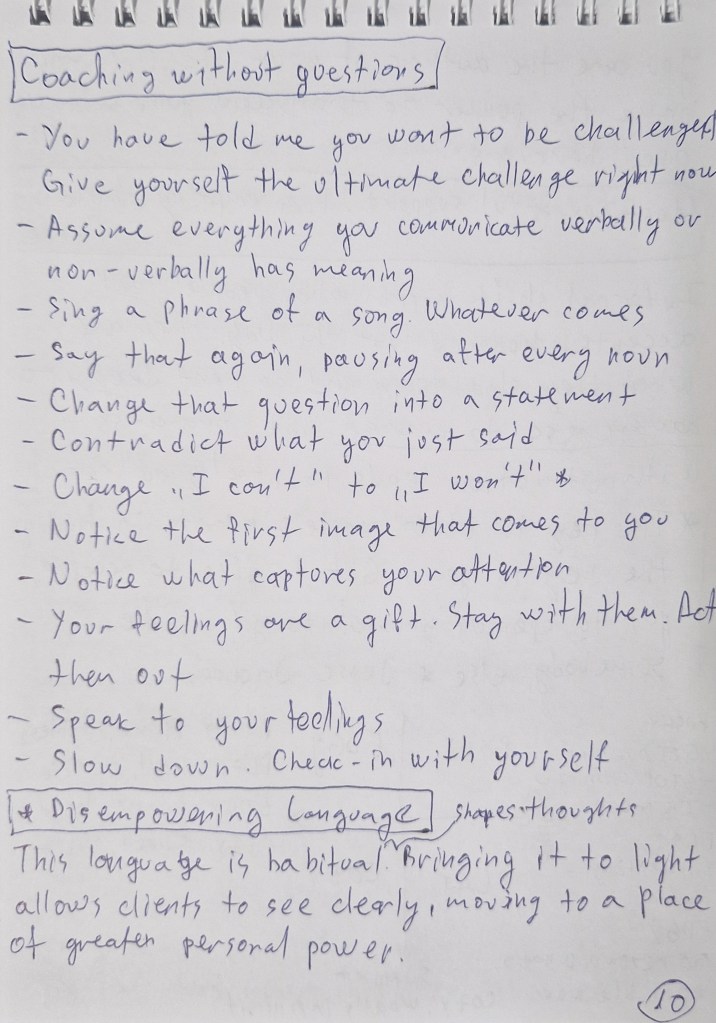
Took notes in a different format this time 🙂 using good ol’ pen-and-paper, rather than computer. (Related writing here).
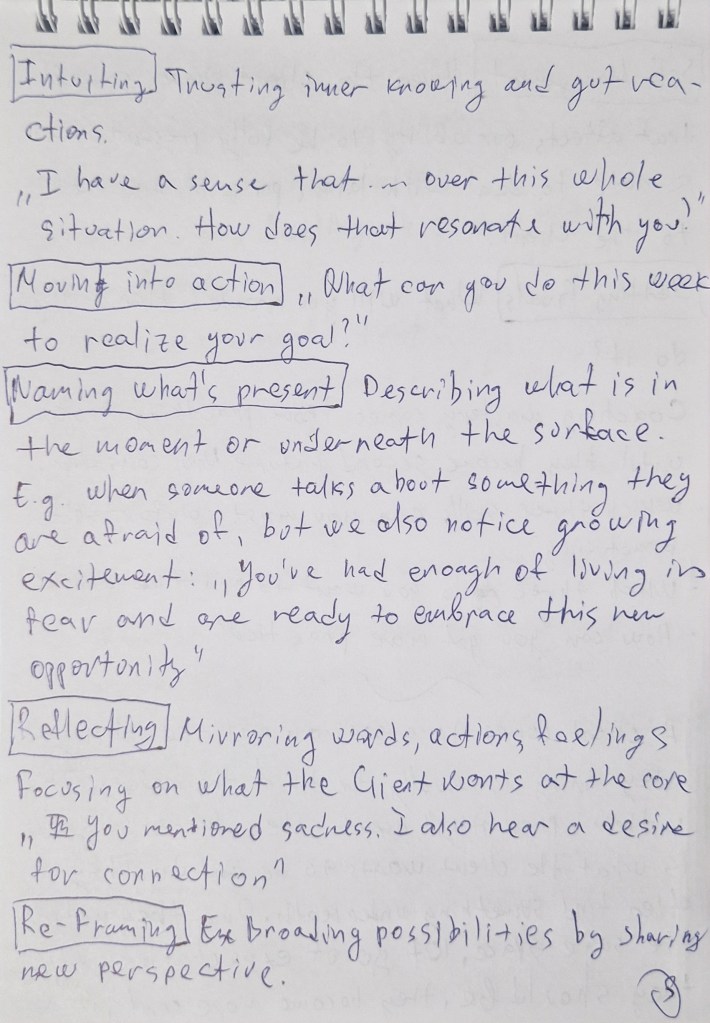
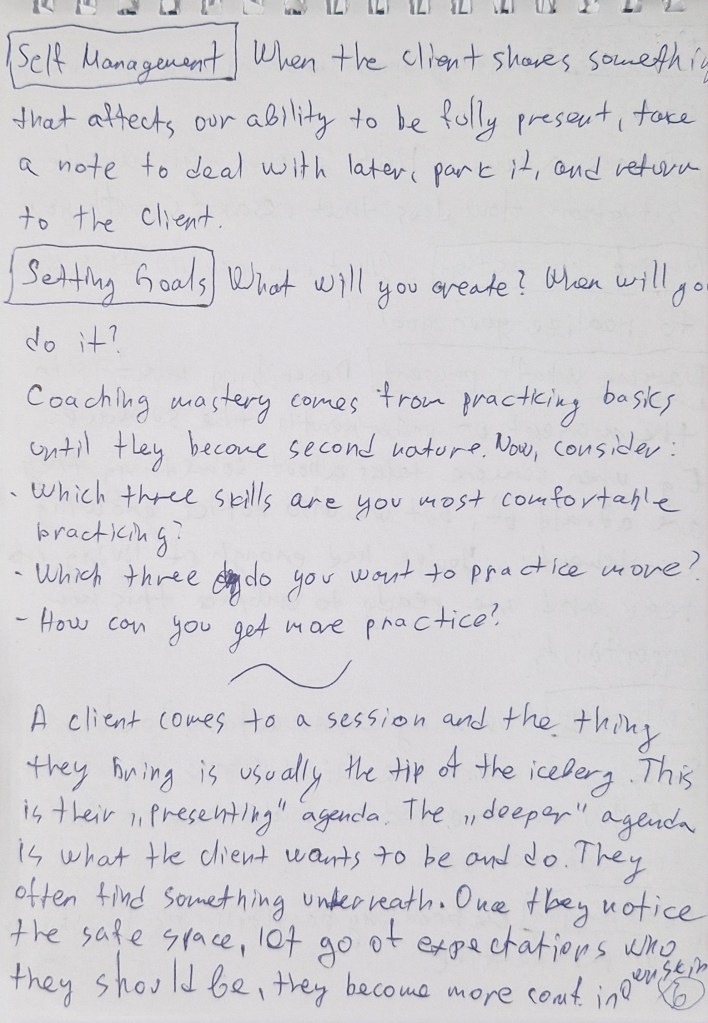
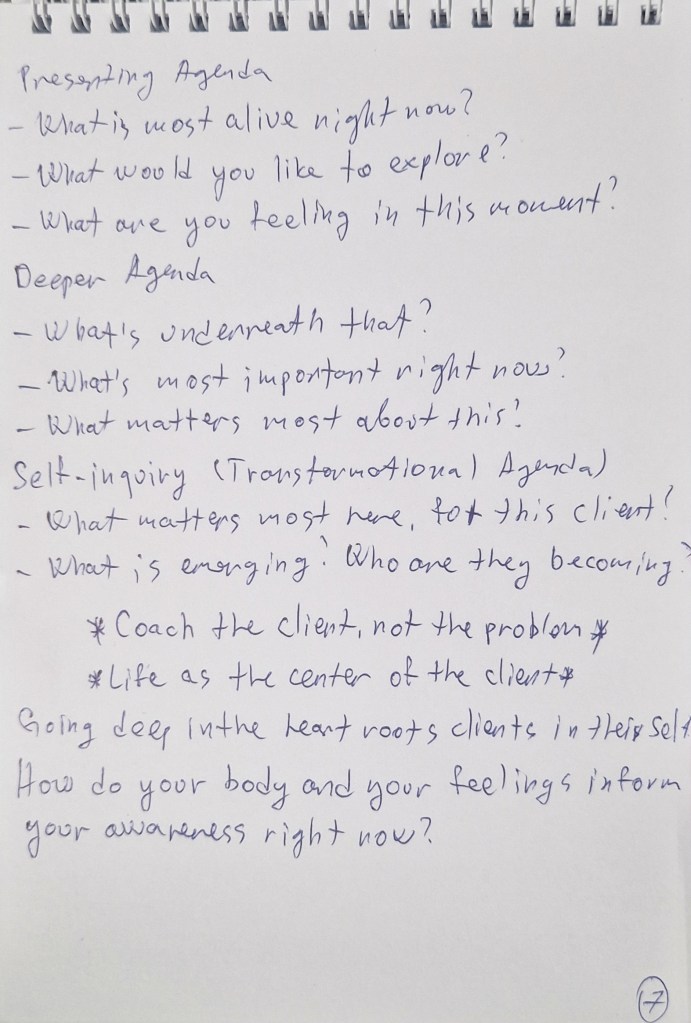
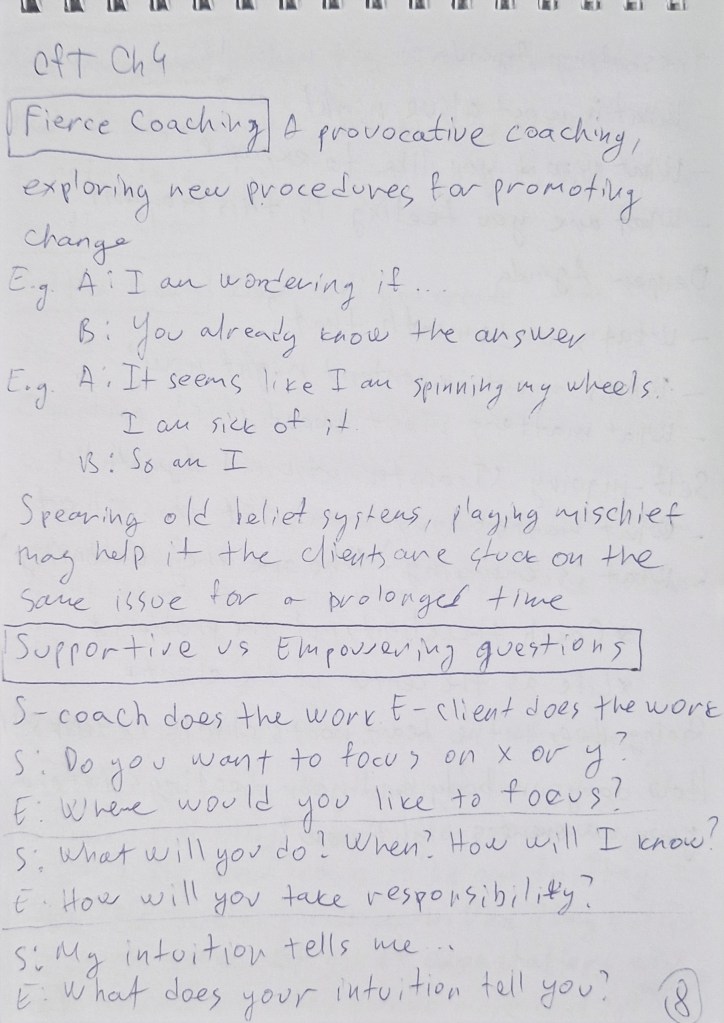
Chapter 4

 bor0's reflective blog