I used to play a lot of video games, and nowadays not that many. But I have never written a game overview. I believe this game deserved one.
Continue reading “Superliminal game overview”Category: Life
Stay Home
I would like to mathematically demonstrate how important it is to stay home in times like these. My article will be a very short version of the cite below. Let’s start with a simple task:
Begin by asking how a rumor might spread among a population. Suppose on Day 1 a single person tells someone else a rumor, and suppose that on every subsequent day, each person who knows the rumor tells exactly one other person the rumor. Have students ponder, discuss and answer questions like: “How many days until 50 people have heard the rumor? 100 people? The whole school? The whole country?Exponential Outbreaks: The Mathematics of Epidemics
Wisdom of the crowd exercise
According to Wikipedia, the wisdom of the crowd is the collective opinion of a group of individuals rather than that of a single expert. An explanation for this phenomenon is that there is idiosyncratic noise associated with each individual judgment, and taking the average over a large number of responses will go some way toward canceling the effect of this noise.
We’ll take the results of a YouTube video as an example, to test the wisdom of the crowd. I used Majk’s Show as a dataset. It’s a young local guy that interviews random people on the streets, asking them random questions.
We will agree that any hits above 50% will validate the wisdom of the crowd. Follows a table with results:
| Question | Answer | Correct answers (%) | Valid? |
| How do you pronounce “schedule” | sheh·jool or skeh·jool | 13/34 = 38.23% | No |
| Who’s the man on the picture | Albert Einstein | 14/32 = 43.75% | No |
| 8/2(2+2)=? | 16 | 11/25 = 44% | No |
| What’s closer, America or the Moon? | America | 9/22 = 40.9% | No |
| Who was the first president of Macedonia? | Kiro Gligorov | 22/50 = 44% | No |
| What is larger: -4 or -10? | -4 | 20/36 = 55.55% | Yes |
We can further categorize the questions and see where the wisdom of the crowd fails specifically. For example, English seems to be below 40% while everything else is above 40%.
In any case, I think I might have set a bit high grading point for the citizens of my country 🙂 But at least they seem to know how to compare two numbers!
GEB: An EGB overview (Part I)
I’d started some time ago, and just recently finished reading the first part of Gödel, Escher, Bach: An Eternal Golden Braid. Here, I will present my quick overview of each chapter.
Idea: news diversity
As with most of my mornings, they start with a coffee and reading the news on time.mk – news portals' aggregator.
At the time of writing this post, there are about 115 sources on the sources list on time.mk. As readers, we are mostly interested in unique content. Out of those 115 sources, a lot of them will generate noise. It may look something like this:
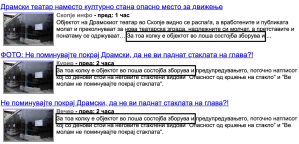
Even if you don’t understand Cyrillic, you can tell it’s definitely the same text.
So, how do we find the most unique sources and only stick to them, instead of wasting our time on copy-paste news portals that do not produce original content?
 bor0's reflective blog