Recently I finished Bobby Fischer Teaches Chess. It’s a book explaining the concept of chess and some basic tactics, containing 275 puzzles. In this post, I’ll write a summary about it.
The book contains an introductory chapter in which the basics of chess are explained. It further proceeds with 6 chapters, each chapter explaining different tactics by showing and asking the reader to solve puzzles.
The essential feature of the book is the concept of programs. Except for the introductory chapter, all chapters contain programs. A program is a frame that contains a chessboard where all of the figures are in some state, and then asks you some questions about that state. The validity of your answer can be instantly checked, by flipping to the next page.
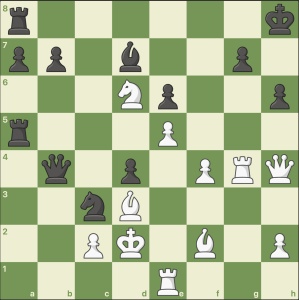
(FEN code:
r6k/pp1b2p1/3Np2p/r3P3/1q1p1PRQ/2nB4/2PK1B1P/4R3 w - - 0 1)And that’s it. Every page of the book contains setups like these in which you have to evaluate the state yourself and arrive at an answer.
I think this way of writing a book is very helpful in teaching one how to evaluate chess positions. It improves the “chess evaluator” in one’s mind. The biggest drawback is that it reads a bit mechanically, and it’s not engaging at all – it assumes the reader is already engaged.
And here’s my solution to 275: Yes, white can mate. The mate sequence starts with the Queen moving to the h6 square, capturing the pawn and giving a check to the King (Qxh6+). There are two ways the King can get out of check:
- By capturing the Queen with the pawn (
gxh6). In which case, the King will be checked again with the knight, giving checkmate (Nf7#) - King runs to the g8 square (
Kg8). In which case, the King will be checked again with the Queen, giving checkmate (Qg7#)
In either case, it’s a checkmate.
Did this solution read like mathematical proof? 🙂 I will talk more about chess and why it’s interesting to me in some of the upcoming blog posts.

 bor0's reflective blog
It’s so much fun to do this thing manually that computers can do faster and better than us 🙂
Automattic has a chess club on chess.com
https://www.chess.com/club/automattic
LikeLiked by 1 person
If you want crisp math-like precision in chess, you should look into *composed* problems. It’s an art form in fact (no kidding) and that precision is part of the aesthetics.
LikeLiked by 1 person