I recently caught Before the Flood randomly on Nat Geo TV. I saw DiCaprio’s interview with Pope Francis, which then led me to Pope Leo‘s Wiki entry, and I found that this book was a great influence on him, so I read it over the weekend (available for free here).
In this blog post, I’ll share a few paragraphs that I found touching or resonating.
Introduction & Preface
The value of this little book is its extreme simplicity. The trouble with most of the religion of the day is its extreme complexity.
The book has, within a short time, gone through repeated editions, and has been a means of blessing to many souls. It contains very much of that wisdom which only lips the Lord has touched can express, and which only hearts He has made teachable can receive. May this edition also be blessed by God, and redound to the praise of the glory of His grace.
Conversations
“The time of business,” said he, “does not with me differ from the time of prayer”
That he was pleased when he could take up a straw from the ground for the love of God, seeking Him only, and nothing else, not even His gifts.
That to arrive at such resignation as God requires, we should watch attentively over all the passions which mingle as well in spiritual things as in those of a grosser nature; that God would give light concerning those passions to those who truly desire to serve Him.
That when an occasion of practising some virtue offered, he addressed himself to God, saying, Lord, I cannot do this unless Thou enablest me; and that then he received strength more than sufficient.
That we ought to act with God in the greatest simplicity, speaking to Him frankly and plainly, and imploring His assistance in our affairs, just as they happen. That God never failed to grant it, as he had often experienced.
in his business in the kitchen (to which he had naturally a great aversion), having accustomed himself to do everything there for the love of God, and with prayer, upon all occasions, for His grace to do his work well, he had found everything easy, during fifteen years that he had been employed there.
That with him the set times of prayer were not different from other times; that he retired to pray, according to the directions of his superior, but that he did not want such retirement, nor ask for it, because his greatest business did not divert him from God.
That useless thoughts spoil all; that the mischief began there; but that we ought to reject them as soon as we perceived their impertinence to the matter in hand, or our salvation, and return to our communion with God.
That we ought to make a great difference between the acts of the understanding and those of the will; that the first were comparatively of little value, and the others, all. That our only business was to love and delight ourselves in God.
that he was careful for nothing and feared nothing, desiring only one thing of God, viz., that he might not offend Him.
That when sometimes he had not thought of God for a good while, he did not disquiet himself for it; but, after having acknowledged his wretchedness to God, he returned to Him with so much the greater trust in Him as he had found himself wretched through forgetting Him.
That the trust we put in God honors Him much and draws down great graces.
That it was impossible not only that God should deceive, but also that He should long let a soul suffer which is perfectly resigned to Him, and resolved to endure everything for His sake.
When outward business diverted him a little from the thought of God, a fresh remembrance coming from God invested his soul,
That in difficulties we need only have recourse to Jesus Christ, and beg His grace; with that everything became easy.
That many do not advance in the Christian progress because they stick in penances and particular exercises, while they neglect the love of God, which is the end.
That there needed neither art nor science for going to God, but only a heart resolutely determined to apply itself to nothing but Him, or for His sake, and to love Him only.
That we might accustom ourselves to a continual conversation with Him, with freedom and in simplicity. That we need only to recognize God intimately present with us, to address ourselves to Him every moment, that we may beg His assistance for knowing His will in things doubtful, and for rightly performing those which we plainly see He requires of us, offering them to Him before we do them, and giving Him thanks when we have done.
That God never failed offering us His grace at each action; that he distinctly perceived it, and never failed of it, unless when his thoughts had wandered from a sense of God’s presence, or he had forgotten to ask His assistance.
That God always gave us light in our doubts when we had no other design but to please Him.
That the most excellent method he had found of going to God was that of doing our common business without any view of pleasing men, and (as far as we are capable) purely for the love of God.
That it was a great delusion to think that the times of prayer ought to differ from other times; that we are as strictly obliged to adhere to God by action in the time of action as by prayer in the season of prayer.
That we ought not to be weary of doing little things for the love of God, who regards not the greatness of the work, but the love with which it is performed.
That the end we ought to propose to ourselves is to become, in this life, the most perfect worshipers of God we can possibly be, as we hope to be through all eternity.
That the greater perfection a soul aspires after, the more dependent it is upon divine grace.
That when he began his business, he said to God, with a filial trust in Him: O my God, since Thou art with me, and I must now, in obedience to Thy commands, apply my mind to these outward things, I beseech Thee to grant me the grace to continue in Thy presence; and to this end do Thou prosper me with Thy assistance, receive all my works, and possess all my affections.
When he had finished he examined himself how he had discharged his duty; if he found well, he returned thanks to God; if otherwise, he asked pardon, and, without being discouraged, he set his mind right again, and continued his exercise of the presence of God as if he had never deviated from it.
Letters
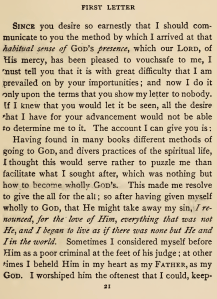
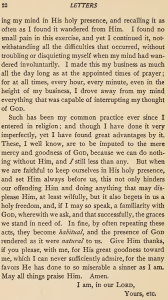
For the first year I commonly employed myself during the time set apart for devotion with the thought of death, judgment, heaven, hell, and my sins. Thus I continued some years, applying my mind carefully the rest of the day, and even in the midst of my business, to the presence of God, whom I considered always as with me, often as in me.
During this time I fell often, and rose again presently.
And I make it my business only to persevere in His holy presence, wherein I keep myself by a simple attention, and a general fond regard to God, which I may call an actual presence of God; or, to speak better, an habitual, silent, and secret conversation of the soul with God, which often causes me joys and raptures inwardly, and sometimes also outwardly, so great that I am forced to use means to moderate them and prevent their appearance to others.
I consider myself as the most wretched of men, full of sores and corruption, and who has committed all sorts of crimes against his King. Touched with a sensible regret, I confess to Him all my wickedness, I ask His forgiveness, I abandon myself in His hands that He may do what He pleases with me. The King, full of mercy and goodness, very far from chastising me, embraces me with love, makes me eat at His table, serves me with His own hands, gives me the key of His treasures; He converses and delights Himself with me incessantly, in a thousand and a thousand ways,
My most useful method is this simple attention, and such a general passionate regard to God, to whom I find myself often attached with greater sweetness and delight than that of an infant at the mother’s breast; so that, if I dare use the expression, I should choose to call this state the bosom of God, for the inexpressible sweetness which I taste and experience there.
You must know his continual care has been, for about forty years past that he has spent in religion, to be always with God, and to do nothing, say nothing, and think nothing which may displease Him, and this without any other view than purely for the love of Him, and because He deserves infinitely more. He is now so accustomed to that divine presence
If sometimes he is a little too much absent from that divine presence, God presently makes Himself to be felt in his soul to recall him, which often happens when he is most engaged in his outward business.
My God, here I am all devoted to Thee. Lord, make me according to Thy heart.
God, saith he, has infinite treasure to bestow, and we take up with a little sensible devotion, which passes in a moment. Blind as we are, we hinder God and stop the current of His graces. But when He finds a soul penetrated with a lively faith, He pours into it His graces and favors plentifully; there they flow like a torrent which, after being forcibly stopped against its ordinary course, when it has found a passage, spreads itself with impetuosity and abundance.
Yes, we often stop this torrent by the little value we set upon it. But let us stop it no more; let us enter into ourselves and break down the bank which hinders it. Let us make way for grace.
those who have the gale of the Holy Spirit go forward even in sleep. If the vessel of our soul is still tossed with winds and storms, let us awake the Lord, who reposes in it, and He will quickly calm the sea.
God will possess the heart alone; and as He cannot possess it alone without emptying it of all besides, so neither can He act there, and do in it what He pleases, unless it be left vacant to Him.
There is not in the world a kind of life more sweet and delightful than that of a continual conversation with God.
yet I do not advise you to do it from that motive. It is not pleasure which we ought to seek in this exercise; but let us do it from a principle of love, and because God would have us.
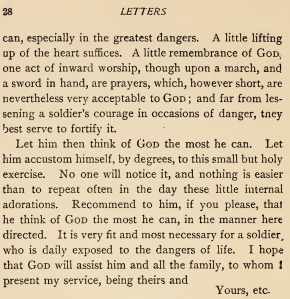
He requires no great matters of us: a little remembrance of Him from time to time; a little adoration; sometimes to pray for His grace, sometimes to offer Him your sufferings, and sometimes to return Him thanks for the favors He has given you, and still gives you, in the midst of your troubles, and to console yourself with Him the oftenest you can. Lift up your heart to Him, sometimes even at your meals, and when you are in company; the least little remembrance will always be acceptable to Him. You need not cry very loud; He is nearer to us than we are aware of.
Let us thus think often that our only business in this life is to please God, and that all besides is but folly and vanity. You and I have lived about forty years in religion (i.e., a monastic life). Have we employed them in loving and serving God, who by His mercy has called us to this state, and for that very end? I am filled with shame and confusion when I reflect, on one hand, upon the great favors which God has done, and incessantly continues to do me; and on the other, upon the ill use I have made of them, and my small advancement in the way of perfection.
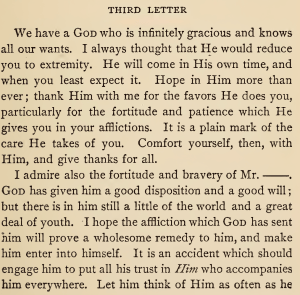
We cannot escape the dangers which abound in life without the actual and continual help of God. Let us, then, pray to Him for it continually.
We must know before we can love. In order to know God, we must often think of Him; and when we come to love Him, we shall then also think of Him often, for our heart will be with our treasure.
Happy those who suffer with Him. Accustom yourself to suffer in that manner, and seek from Him the strength to endure as much, and as long, as He shall judge to be necessary for you.
God often permits that we should suffer a little to purify our souls and oblige us to continue with Him. Take courage; offer Him your pains incessantly; pray to Him for strength to endure them. Above all, get a habit of entertaining yourself often with God, and forget Him the least you can. Adore Him in your infirmities, offer yourself to Him from time to time, and in the height of your sufferings beseech Him humbly and affectionately (as a child his father) to make you conformable to His holy will. I shall endeavor to assist you with my poor prayers.
He never forsakes us until we have first forsaken Him. Let us fear to leave Him. Let us be always with Him. Let us live and die in His presence. Do you pray for me as I for you.
I am in pain to see you suffer so long. What gives me some ease and sweetens the feelings I have for your griefs is that they are proofs of God’s love toward you. See them in that view and you will bear them more easily.
Love sweetens pains; and when one loves God, one suffers for His sake with joy and courage.
He is the Father of the afflicted, always ready to help us. He loves us infinitely, more than we imagine. Love Him, then, and seek no consolation elsewhere. I hope you will soon receive it.
We must make our heart a spiritual temple, wherein to adore Him incessantly. We must watch continually over ourselves, that we may not do nor say nor think anything that may displease Him.
Let all our employment be to know God; the more one knows Him, the more one desires to know Him. And as knowledge is commonly the measure of love, the deeper and more extensive our knowledge shall be, the greater will be our love; and if our love of God were great, we should love Him equally in pains and pleasures.
I cannot thank Him sufficiently for the relaxation He has vouchsafed you. I hope from His mercy the favor to see Him within a few days.* Let us pray for one another.
*: He took to his bed two days after, and died within the week.
First letter verbatim
Third letter verbatim
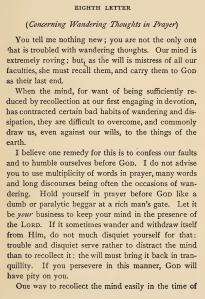
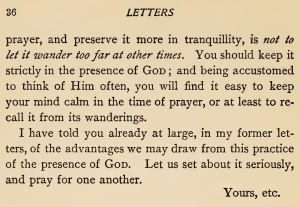
Eighth letter verbatim

 bor0's reflective blog