I recently bought another psychology book at the bookstore. As I read it, I thought of myself, and the people I interact with daily and how some principles do or do not apply to me and them.
Continue reading “Read People Like a Book”Category: Life
Introduction to Psychology overview
Recently I wrapped Yale’s Introduction to Psychology course at Coursera. I will post my notes/overview here. The certificate can be downloaded here.
Continue reading “Introduction to Psychology overview”The Courage to be Disliked overview
I bought this book recently and went through it in a single weekend. It reads very easily. The book is a dialogue between a philosopher and a young person; naturally, in the beginning, the young person is very skeptical about what the philosopher has to say. They discuss philosophical and psychological concepts in five days, and each day is a separate chapter, whereas each chapter is 40 pages on average.
The authors are mainly inspired by the psychologist Alfred Adler and use many of his concepts/ideas, but they also find inspiration in Socrates, Platon, Aristotle.
Continue reading “The Courage to be Disliked overview”Some thoughts on recent self-reflections
As I reflect on my pattern of thoughts lately, I noticed how I often “step out” and think of things at a higher level, e.g., trying to justify some justifications, etc. Where does this change come from? I’d assume it has to do with me reading a lot of philosophy lately 🙂 I’ll post some brief random thoughts here about this matter.
Continue reading “Some thoughts on recent self-reflections”First talk on DevEx & DevRel
At the WordPress 31st Skopje Meetup, my friend and I presented on the topic of DevEx & DevRel.
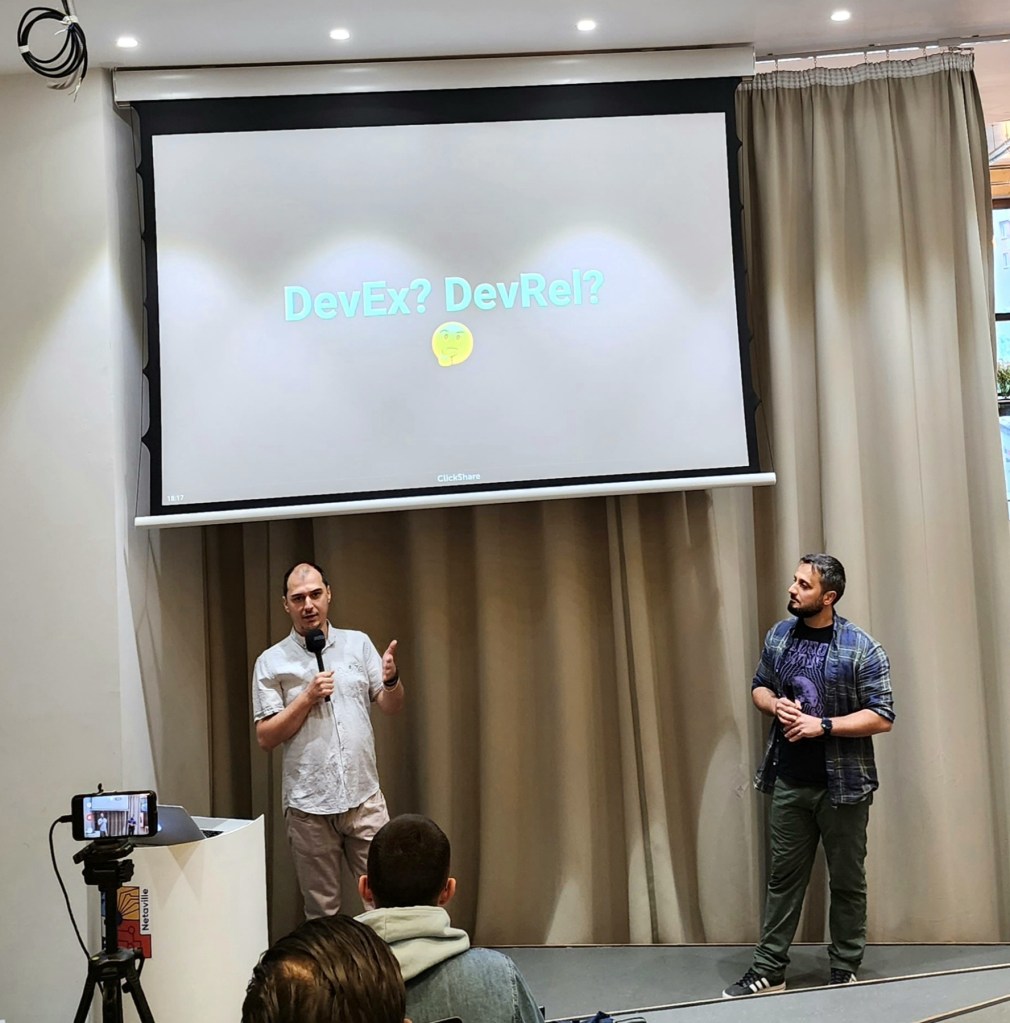
Here is a brief summary of some of the stuff we talked about:
- There is no single definition of DevEx/DevRel. Our take is that it’s like a tourist guide that spreads the word (company culture) across.
- It can be seen as an engineering intersection with one or more of {HR, Marketing, Product, Community, Content}
- The three pillars Product+Community+Content are useful fictions and a lot of stuff overlaps between these
- Community: meetups, conferences, workshops, hiring, mentorship…
- Content: blogging, documentation, tutorials, podcasts, talks…
- Product: coding examples, integrations, collecting and applying feedback, tooling, processes…
- Developers by nature are skeptical folks * – we can achieve much more by doing “indirect marketing” (things such as mentorship, bottle pickup, content writing, etc.) with the hope they follow along and improve – more specifically, they see “by example” why some things are useful doing and they eventually start doing it themselves. This approach is in contrast with e.g. “let’s actively teach you [X] so that you will be better at [Y]”, where I think this will repel more than attract.
- DevEx exists because of the intersectional voids between engineering and [X]. Building relations/partnerships helps fill these voids.
- Measure success in terms of lifetime value rather than OKRs – you can measure how many fishes someone fished but you can’t really measure how you taught someone to fish.
- Why DevEx/mentorship: Third perspective argument – developers get easily stuck in a cycle when programming (focused work) and it is easy to “forget” the big picture.
* This argument is of the form “Everybody is a skeptic” – you either agree with it, or you don’t, which proves the point in any case. One can argue it’s an unfair argument 🙂

